

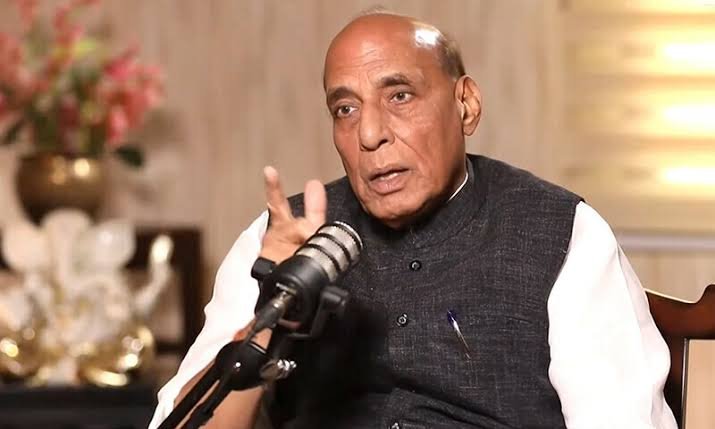
Defence Minister Rajnath Singh’s latest remarks on Pakistan during Kargil Vijay Diwas have reinforced India’s existing national security doctrine. His statements reflect a continued emphasis on counterterrorism, territorial integrity, and a tougher diplomatic posture amid ongoing regional tensions.
The topic is time-sensitive news, so this article is written in a news reporting style based on the latest verified developments.
The latest Rajnath Singh Pakistan remarks have once again brought India’s national security policy into focus. Speaking at the Kargil War Memorial in Dras on the 27th Kargil Vijay Diwas, Defence Minister Rajnath Singh delivered a strong message on India’s approach towards Pakistan, terrorism, and Pakistan-occupied Kashmir (PoK). He stated that there would be no talks with Pakistan under the current circumstances and that any future dialogue, if held, would only concern PoK. He also said that India would respond decisively to any future hostile actions against its sovereignty.
The remarks come at a time when India continues to maintain a firm position on cross-border terrorism and regional security. While the statements do not represent a formal change in policy, they reaffirm the government’s existing approach towards national defence and diplomatic engagement with Pakistan.
Rajnath Singh’s Key Remarks at Kargil Vijay Diwas
Addressing soldiers, veterans, and officials at the Kargil Vijay Diwas event, Rajnath Singh said that India’s experience during Operation Sindoor demonstrated the country’s capability to respond strongly to threats originating from across the border. He warned that any future “misadventure” by Pakistan would invite a response stronger than expected.
The Defence Minister also reiterated that India currently sees no scope for bilateral dialogue with Pakistan. According to his statement, if talks were ever to take place, they would be limited to the issue of Pakistan-occupied Kashmir, which India considers an integral part of its territory.
He further accused Pakistan of continuing to support terrorism and infiltration, contrasting India’s focus on innovation, defence manufacturing, and economic development with what he described as Pakistan’s continued reliance on extremist networks.
What These Remarks Mean for India’s Security Policy
India’s security policy has steadily evolved over the past decade toward a doctrine that combines diplomatic pressure with the willingness to respond militarily to cross-border terrorist attacks when necessary.
Rajnath Singh’s speech reinforces several elements of this strategy.
First, it underlines India’s continued policy of zero tolerance toward terrorism. Indian officials have repeatedly maintained that meaningful engagement with Pakistan depends on credible action against terrorist infrastructure operating from its territory.
Second, the remarks indicate continuity rather than a policy shift. India has consistently maintained that terrorism and dialogue cannot progress simultaneously unless there is visible action against cross-border terror groups.
Third, the emphasis on PoK reflects India’s long-standing constitutional and diplomatic position regarding the region. Singh’s comments are aligned with previous statements made by senior government leaders on the issue.
Impact on India-Pakistan Relations
Although strong political statements often attract significant attention, they do not automatically translate into immediate policy changes or military action.
Relations between India and Pakistan remain limited, with formal bilateral engagement already constrained by longstanding disputes and security concerns. Singh’s remarks reinforce India’s current diplomatic position rather than announcing new negotiations or fresh military measures.
Pakistan responded by criticizing the Defence Minister’s comments and rejecting India’s position on Kashmir, highlighting the continued differences between the two countries on regional issues.
Security analysts generally note that such statements serve multiple purposes. They reassure domestic audiences about national security, communicate deterrence to adversaries, and reinforce India’s official diplomatic stance before the international community.
The Role of Kargil Vijay Diwas in the Message
The timing of the remarks is significant.
Kargil Vijay Diwas commemorates India’s victory in the 1999 Kargil conflict and honours the soldiers who lost their lives defending the country’s territorial integrity. Speeches delivered during the annual event often highlight military preparedness, national unity, and strategic lessons from the conflict.
By linking Operation Sindoor with the legacy of Kargil, Rajnath Singh sought to project continuity in India’s defence doctrine. His speech emphasized preparedness, self-reliance in defence production, and the Armed Forces’ ability to respond effectively to future security challenges.
The address also highlighted India’s ongoing investments in indigenous defence manufacturing and technological capability, both of which have become central pillars of the country’s long-term national security strategy.
What to Watch Going Forward
While Rajnath Singh’s remarks have generated political and diplomatic attention, the practical implications will depend on developments along the India-Pakistan border and broader regional security conditions.
Observers will closely monitor future diplomatic exchanges, cross-border security incidents, and any official announcements from both governments. India’s broader strategic priorities, including strengthening border infrastructure, expanding indigenous defence production, enhancing intelligence capabilities, and improving military readiness, are expected to remain unchanged.
For now, the Defence Minister’s speech signals policy continuity rather than a departure from India’s established security approach.
Key Takeaways
- Rajnath Singh said any future talks with Pakistan would only concern Pakistan-occupied Kashmir.
- The Defence Minister reiterated India’s zero-tolerance approach toward cross-border terrorism.
- The remarks reinforce India’s existing national security doctrine rather than announcing a new policy.
- The speech was delivered during the 27th Kargil Vijay Diwas, emphasizing military preparedness and strategic deterrence.
FAQ
Q1. What did Rajnath Singh say about Pakistan?
He said there would be no talks with Pakistan under the current circumstances, and if talks were to happen, they would only be about Pakistan-occupied Kashmir.
Q2. Why are these remarks significant?
They reaffirm India’s current security policy on terrorism, border security, and diplomatic engagement with Pakistan.
Q3. Do the remarks indicate a change in India’s foreign policy?
No. The statements largely reinforce positions that the Indian government has maintained in recent years regarding terrorism and bilateral relations.
Q4. Where were the remarks made?
Rajnath Singh delivered the speech at the Kargil War Memorial in Dras during the 27th Kargil Vijay Diwas commemorations.












Leave a comment