

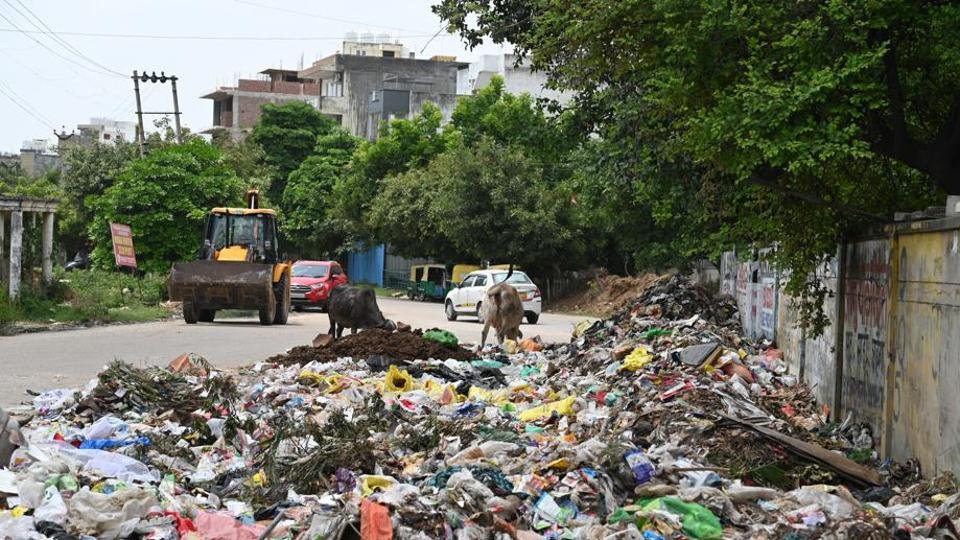
Gurugram’s garbage crisis has intensified in August 2026, with uncollected waste piling up amid a sanitation workers’ strike and continuing problems with waste collection contracts. The situation has exposed deeper questions about how fast-growing Indian cities collect, process and dispose of urban waste.
Gurugram garbage crisis enters another difficult phase
The Gurugram garbage crisis has become a visible civic problem this month as waste collection has been disrupted across parts of the city. A sanitation workers’ strike has added pressure to an already strained waste management system, with residents reporting garbage accumulation on roads and around collection points. The Tribune reported that the crisis had entered its fifth major episode in two years, while Resident Welfare Associations have sought greater municipal control over sanitation services.
The immediate problem is simple to see: when waste is not collected regularly, it accumulates quickly. But Gurugram’s situation points to a larger issue. Waste management is not only about sending vehicles to collect household garbage. It involves manpower, contracts, transportation, segregation, processing facilities, landfill capacity and monitoring.
When one part fails, the entire chain can be affected.
Sanitation strike puts pressure on waste collection
The current disruption has also brought the role of sanitation workers into sharper focus. Reports indicate that workers have been protesting over employment-related demands, including the reinstatement of workers and concerns over outsourcing and contractual employment.
For a city generating large quantities of household and commercial waste every day, even a temporary reduction in sanitation capacity can create visible consequences.
Garbage that normally moves from homes to collection vehicles can remain outside for days. During the monsoon, the problem becomes more complicated because wet waste decomposes faster and can produce foul odours. Waste lying near roads and drains can also become harder to manage after rainfall.
This shows why municipal sanitation cannot depend entirely on emergency responses. Cities need contingency arrangements that can keep essential collection services functioning even when contractual or labour disputes occur.
Short-term waste contracts create another challenge
Gurugram’s problem is not limited to the current strike.
A report published by Hindustan Times on August 20 said the city’s waste-management crisis is also being compounded by the absence of a long-term contract for door-to-door garbage collection. The report said the Municipal Corporation of Gurugram spent ₹22.5 crore on door-to-door collection and ₹12.5 crore on sweeping and other sanitation services between April 2025 and July 2026.
The contract structure matters because waste collection requires predictable operations. Vehicles have to be deployed daily, workers need to be available, routes need to be monitored and waste needs to reach designated processing or disposal facilities.
Frequent changes or gaps in contracts can make accountability more difficult. When service levels fall, residents may not always know whether the responsibility lies with the contractor, the municipal corporation or another agency.
Missing vehicles raise questions about monitoring
Another concern emerged earlier this year when a physical verification exercise reportedly found a significant gap between the number of waste collection vehicles contracted and the number actually available on the ground.
The Tribune reported in July that more than 220 vehicles were missing from a contracted fleet of 591, representing roughly 40% of the mandated vehicles. The Municipal Corporation subsequently initiated action against a private agency responsible for collection in five wards and proposed termination and blacklisting proceedings.
The episode highlights an important aspect of urban waste management: contracts alone do not guarantee services.
Municipal authorities need reliable systems to verify whether vehicles are operating, whether routes are being covered and whether collected waste is reaching the correct destination. GPS tracking, route audits, vehicle inspections and transparent performance data can help, but only when these systems are actively monitored.
Bandhwari landfill shows the problem beyond collection
Gurugram’s waste challenge also extends beyond the streets.
The Bandhwari landfill has been at the centre of the city’s long-running waste management problems. According to a report published by Hindustan Times on August 20, the Municipal Corporation of Gurugram told the National Green Tribunal that around 710,000 metric tonnes of waste could remain unprocessed at the site even after the current processing arrangements continue until March 2027.
This is significant because it shows the difference between waste collection and waste management.
Removing garbage from a residential area may make a neighbourhood look cleaner, but the waste still has to go somewhere. If processing capacity does not keep pace with waste generation, the problem simply moves from streets to transfer stations, dumping grounds or landfill sites.
A sustainable system therefore has to focus on processing and recovery, not only collection.
Why waste segregation matters for Indian cities
One of the biggest opportunities for improving urban waste management is segregation at source.
Household waste typically contains different materials, including wet organic waste, recyclable materials and items that require specialised disposal. When these materials are mixed together, recovery becomes more difficult and the amount requiring final disposal increases.
Segregation can make composting, recycling and other forms of processing more efficient.
However, segregation cannot work through household participation alone. Collection vehicles need separate compartments or appropriate handling systems, waste workers need training, and processing facilities must be capable of receiving segregated material.
The lesson from Gurugram is that every stage of the system has to work together.
Gurugram’s construction waste adds another layer
The city’s waste challenge also includes construction and demolition waste generated by its rapid urban development.
Construction debris can accumulate around vacant plots, roadsides and other open spaces when collection and disposal systems are inadequate. Gurugram’s rapid expansion, redevelopment and construction activity make this category particularly important.
This is different from ordinary household waste and requires dedicated collection, transportation and processing arrangements.
The broader point is that modern cities cannot use one waste strategy for every category. Household garbage, construction debris, horticulture waste, electronic waste and hazardous waste have different handling requirements.
A city that grows rapidly needs its waste infrastructure to grow at the same pace.
Why monsoon makes the garbage problem worse
The timing of the current crisis also matters.
Gurugram is dealing with the waste problem during the monsoon, when rainfall can turn accumulated garbage into a bigger public infrastructure issue. Wet waste becomes heavier and harder to collect, while plastic and other debris can enter drains.
Gurugram has separately been dealing with extensive waterlogging concerns. The Municipal Corporation and other agencies identified 155 waterlogging hotspots this monsoon, while the city received 97 mm of rainfall on August 7. Authorities have also linked some waterlogging problems to encroachments and unauthorised structures affecting drainage routes.
This does not mean garbage is responsible for all of Gurugram’s waterlogging. Drainage capacity, rainfall intensity, encroachments and infrastructure are separate factors. But waste accumulation can make drainage maintenance more difficult.
That is why waste management and stormwater management need to be treated as connected urban services.
What other Tier-2 and Tier-3 cities can learn
Gurugram’s experience is relevant beyond the National Capital Region.
India’s smaller cities are expanding rapidly, with new housing societies, commercial areas and industrial zones increasing the amount of waste generated. Many municipal bodies are trying to modernise collection systems while working with limited budgets and infrastructure.
The lesson is not that cities should copy Gurugram’s model. It is that urban growth should be planned alongside basic municipal services.
A new residential project needs reliable waste collection. A commercial district needs organised waste handling. Industrial expansion requires appropriate disposal systems. Population growth without matching sanitation capacity eventually creates visible civic problems.
For Tier-2 and Tier-3 cities, investing early in segregation, local processing and accountable collection systems could prevent some of the problems that larger cities are now struggling to manage.
What needs to change in urban waste management
Gurugram’s current crisis suggests that the focus needs to shift from emergency cleaning drives to measurable service delivery.
Municipal bodies need clear standards for collection frequency, vehicle availability, worker deployment and waste processing. Contractors should be evaluated against verified performance rather than simply the number of vehicles or workers mentioned in a contract.
There is also a need for greater transparency. Residents should be able to see whether waste collection is taking place in their area and where complaints stand.
At the same time, citizens have a role in segregating waste, avoiding illegal dumping and following local disposal rules. But public participation cannot compensate for missing infrastructure or inadequate municipal capacity.
The responsibility has to be shared across households, resident associations, contractors and government agencies.
The bigger question for India’s growing cities
Gurugram’s garbage crisis is ultimately about more than piles of waste on roads.
It raises a basic question about urbanisation: can Indian cities expand rapidly while keeping essential civic systems reliable?
Waste management is one of the first services residents notice when a city begins to struggle. Unlike many infrastructure problems hidden underground or inside administrative systems, garbage becomes visible immediately.
The current situation also shows why cities need long-term planning. Collection contracts, sanitation staffing, processing capacity and landfill management cannot be treated as separate issues.
For Gurugram, solving the immediate accumulation of waste is necessary. But the more important task is building a system that does not repeatedly reach the same crisis point.
Key Takeaways
- Gurugram’s current garbage crisis has been intensified by sanitation disruptions and weaknesses in waste collection arrangements.
- Contract monitoring and adequate deployment of collection vehicles remain important concerns for the Municipal Corporation.
- The Bandhwari landfill backlog highlights the difference between collecting waste and actually processing it.
- Other rapidly growing Indian cities can learn from Gurugram by investing early in segregation, local processing, reliable contracts and transparent monitoring.
FAQs
Why is Gurugram facing a garbage crisis in August 2026?
The current crisis has been linked to disruption in sanitation services, including a sanitation workers’ strike, alongside longer-running problems involving waste collection contracts and service delivery.
What is the Bandhwari landfill problem?
Bandhwari is a major waste disposal site associated with Gurugram’s long-running solid waste management challenges. The Municipal Corporation has told the National Green Tribunal that around 710,000 metric tonnes of waste could remain unprocessed by March 2027 under the current projections.
Can better waste segregation solve Gurugram’s garbage problem?
Segregation can improve recycling and organic waste processing, but it cannot solve the entire problem on its own. It must be supported by separate collection systems, processing facilities, trained workers and effective municipal monitoring.
Why is Gurugram’s waste crisis relevant to other Indian cities?
Gurugram is a rapidly expanding urban centre, but similar pressures are emerging in many Tier-2 and Tier-3 cities. Population growth, construction activity and rising consumption can increase waste faster than municipal infrastructure unless collection and processing capacity are planned in advance.
(Internal keyword suggestions: Gurugram garbage crisis, Gurugram waste management, Bandhwari landfill, Municipal Corporation of Gurugram, MCG garbage collection, urban waste management India, solid waste management, sanitation crisis Gurugram, waste segregation India, garbage collection in Gurugram)










Leave a comment