

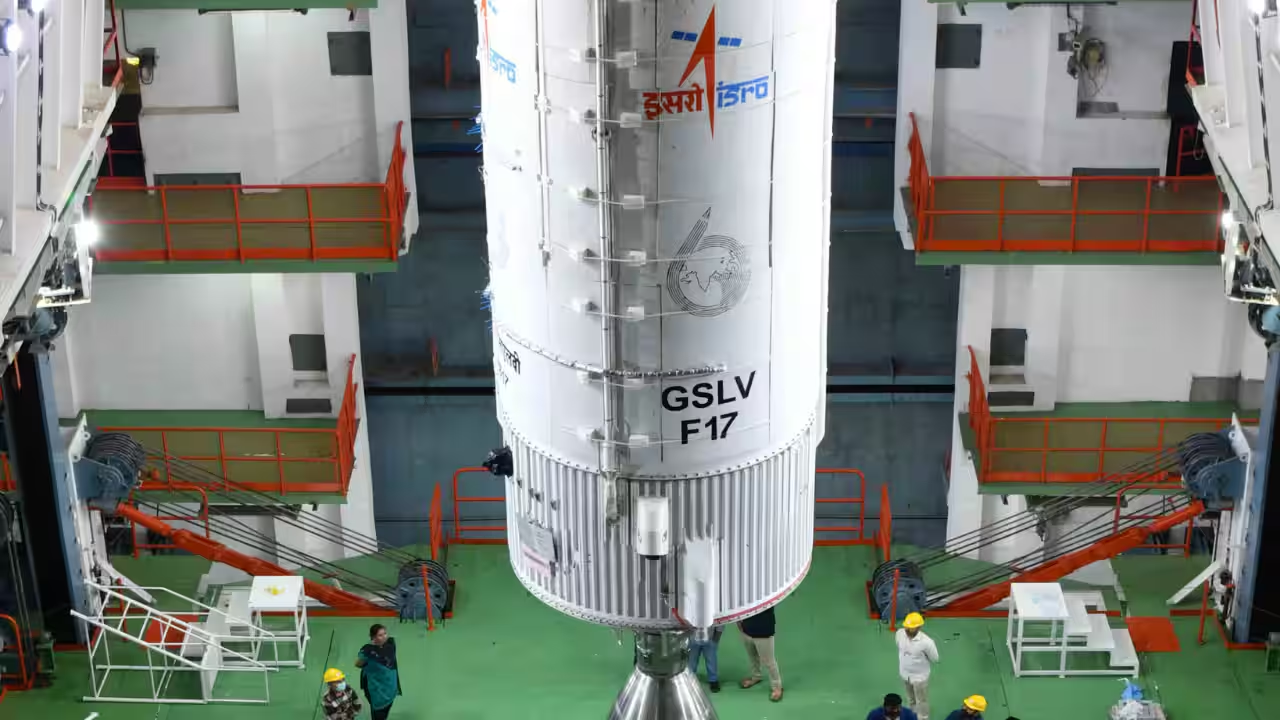
ISRO’s EOS-05 mission is scheduled for launch on September 4, 2026, aboard the GSLV-F17 rocket from Sriharikota. The satellite will be India’s first imaging spacecraft designed to operate from geosynchronous orbit, offering frequent observation of large areas for Earth monitoring and national applications.
EOS-05 launch date, time and mission details
The Indian Space Research Organisation has scheduled the GSLV-F17/EOS-05 mission for 2:55 am IST on September 4, 2026. The launch will take place from the Second Launch Pad at the Satish Dhawan Space Centre in Sriharikota, Andhra Pradesh.
As of September 3, the mission has not yet launched. ISRO officially lists the flight as a scheduled mission and says GSLV-F17 will initially place EOS-05 into a Sub-Geosynchronous Transfer Orbit, or Sub-GTO. GSLV-F17 is the 19th flight of India’s Geosynchronous Satellite Launch Vehicle.
EOS-05 is an Earth observation spacecraft and, according to ISRO, will be India’s first-ever imaging satellite from geosynchronous orbit. The mission is therefore significant not simply because another satellite is being launched, but because it is intended to give India a different kind of Earth-observation capability.
Why the geosynchronous orbit is important
Most Earth observation satellites move around the planet in lower orbits and periodically pass over a particular location. That approach is useful for detailed imaging, but a satellite cannot continuously remain over the same region.
EOS-05 is designed to work differently. Once it reaches its intended geosynchronous operational position, at roughly 36,000 kilometres above Earth, it can remain synchronised with the planet’s rotation and repeatedly observe the same broad region.
That makes the satellite particularly useful when changes need to be followed frequently rather than captured only during occasional passes. Recent reports have highlighted its potential for persistent observation of the Indian region, including remote areas and strategically important locations.
The higher orbit also comes with a trade-off. A satellite operating much farther from Earth generally cannot match the very high spatial resolution achievable by some lower-orbit imaging satellites. EOS-05’s importance instead lies in how frequently it can observe a large area.
What EOS-05 will be used for
Earth observation satellites are not limited to taking photographs. Their data can support government agencies, researchers and other users working on agriculture, weather, disaster management, environmental monitoring and land-use planning.
EOS-05 is expected to add value particularly where frequent observations are important. For example, rapidly changing weather systems can require repeated monitoring. Satellite observations can also assist in assessing the spread and impact of floods, cyclones, forest fires and other large-scale events.
For agriculture, repeated observations can contribute to monitoring vegetation and changes across large areas. Environmental agencies can similarly use Earth observation data to study changes in forests, water bodies and land cover.
The satellite’s potential strategic applications are also attracting attention. Its ability to repeatedly observe a selected region from geosynchronous orbit could strengthen India’s ability to monitor remote and strategically important areas. However, the exact operational uses and performance after deployment will depend on the satellite’s successful launch, orbital placement, commissioning and subsequent data operations.
EOS-05 and India’s earlier GISAT attempt
The EOS-05 mission also has an important history behind it. India had previously attempted to establish a geosynchronous imaging capability with the GISAT-1 mission.
That mission, carried by GSLV-F10, encountered a problem during the cryogenic upper-stage phase after its launch in August 2021 and did not reach its intended orbit. ISRO’s official launch records list GSLV-F10/EOS-03 as an unsuccessful mission.
EOS-05 is associated with the GISAT programme and is also referred to as GISAT-1A in recent reporting. The upcoming launch therefore represents another attempt to establish the type of persistent Earth-imaging capability that India had sought with the earlier mission.
The distinction is important. EOS-05 should not be described as a satellite that has already demonstrated these capabilities. As of September 3, 2026, the spacecraft remains a pre-launch mission, with its launch scheduled for September 4.
How GSLV-F17 will carry EOS-05 into space
The launch vehicle for the mission is GSLV-F17, the 19th flight of the Geosynchronous Satellite Launch Vehicle.
ISRO says the rocket will place EOS-05 into a Sub-Geosynchronous Transfer Orbit. This is not the same as saying that the satellite will immediately be sitting in its final geosynchronous position after liftoff. The transfer orbit is part of the planned route for getting the spacecraft toward its operational orbital regime.
The mission will launch from Sriharikota, India’s primary spaceport. The GSLV-F17 configuration includes a four-metre-diameter ogive composite payload fairing, according to ISRO.
The launch also carries significance for ISRO’s broader programme. The agency has had a gap in major orbital launches since the January 2026 PSLV-C62/EOS-N1 mission encountered an anomaly. ISRO says that anomaly occurred during the PS3 stage and that a detailed analysis was initiated.
Why EOS-05 matters for ordinary Indians
The value of a satellite such as EOS-05 may not be immediately visible to people on the ground. There will be no direct consumer service comparable to a mobile network or navigation app. Its importance is mainly in the information it can provide to institutions that make decisions affecting millions of people.
For a farmer, better satellite monitoring can contribute to improved assessment of crops and changing environmental conditions. For disaster-management authorities, frequent observations can help build a clearer picture of rapidly developing events.
For states such as Maharashtra, Madhya Pradesh, Odisha, Bihar and Assam, where floods, extreme weather, agriculture and forest management are recurring concerns, faster access to Earth observation data can have practical relevance.
The wider significance is that India is expanding the types of satellite platforms it can use. EOS-05 is designed around persistence and frequent observation, while other Earth observation missions can provide different combinations of resolution, coverage and sensing technology.
EOS-05 is about persistence, not just sharper images
One of the easiest ways to misunderstand the mission is to judge EOS-05 only by image resolution.
Its main distinction is the orbital position and the resulting ability to observe a broad region repeatedly. A lower-orbit satellite can offer detailed images because it is much closer to Earth, but it moves rapidly around the planet. EOS-05 is being developed for a different requirement: maintaining a persistent view of a region.
This difference can be particularly valuable during fast-moving events. A flood, cyclone or major cloud system can change significantly within hours. More frequent observations can provide a better sequence of developments than isolated satellite passes.
India already has a substantial Earth observation programme. ISRO also operates and develops satellites serving remote sensing, weather, environmental and disaster-management needs. The EOS-05 mission adds another capability to that larger ecosystem rather than replacing existing satellites.
What happens after the September 4 launch
The launch itself will be only the first stage of the mission. After liftoff and separation, the spacecraft must be placed into the planned transfer orbit and subsequently moved toward its intended operational orbit.
The satellite will then undergo post-launch checks and commissioning before its imaging capabilities can be used operationally. This means the full benefits of EOS-05 will not appear immediately at the moment of liftoff.
For now, the key milestone is the scheduled GSLV-F17 launch at 2:55 am IST on September 4. ISRO’s official mission page confirms the schedule and identifies EOS-05 as India’s first imaging satellite from geosynchronous orbit.
If successful, the mission will mark an important step in India’s Earth observation programme by combining geosynchronous operations with imaging and frequent regional monitoring.
Key Takeaways
- ISRO has scheduled the GSLV-F17/EOS-05 launch for 2:55 am IST on September 4, 2026, from Sriharikota.
- EOS-05 is designed to become India’s first imaging satellite operating from geosynchronous orbit.
- Its major advantage is frequent observation of the same broad region, with potential applications in weather, disasters, agriculture, environment and strategic monitoring.
- The mission follows India’s earlier unsuccessful GISAT-1/EOS-03 attempt in 2021 and represents another effort to establish persistent geosynchronous Earth imaging.
FAQs
What is EOS-05?
EOS-05 is an Earth observation satellite developed by ISRO. The agency describes it as India’s first-ever imaging satellite from geosynchronous orbit.
When will ISRO launch EOS-05?
The GSLV-F17/EOS-05 mission is scheduled for September 4, 2026, at 2:55 am IST from the Second Launch Pad at Satish Dhawan Space Centre, Sriharikota.
Why is EOS-05 being placed in geosynchronous orbit?
A geosynchronous orbit allows the satellite to remain synchronised with Earth’s rotation and repeatedly observe the same broad region. This can be useful for frequent monitoring of weather, disasters, environmental changes and strategically important areas.
Is EOS-05 already in space?
No. As of September 3, 2026, EOS-05 has not yet launched. ISRO lists the GSLV-F17/EOS-05 mission as scheduled for September 4 at 2:55 am IST.
(Internal keyword suggestions: ISRO EOS-05 mission, EOS-05 launch date, GSLV-F17 launch, EOS-05 satellite, GISAT-1A, ISRO Earth observation satellite, geosynchronous satellite India, EOS-05 September 4 2026, ISRO latest mission, India satellite launch)











Leave a comment