

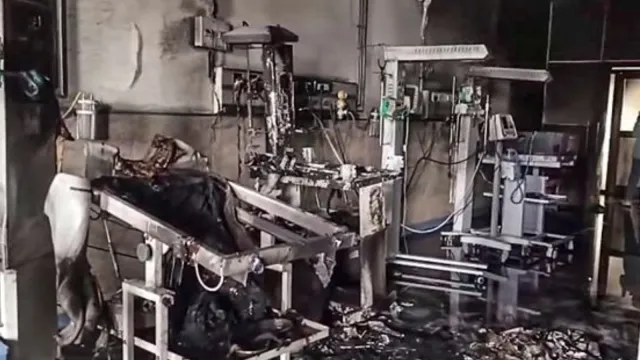
The Amravati hospital fire case has led the Maharashtra government to suspend five officials and initiate action against two private agencies after a high-level inquiry found serious safety and supervisory lapses. The August 24 fire killed three newborns at the Government Women’s Hospital.
Amravati Hospital Fire: What Happened
The Amravati hospital fire occurred on August 24 at the Special Newborn Care Unit of the Government Women’s Hospital, where vulnerable newborns were receiving treatment. Three babies died in the incident, while 36 other newborns were rescued from the affected unit.
According to the findings reported after the inquiry, the incident exposed several problems involving hospital maintenance, fire safety systems and supervision. The inquiry examined whether critical equipment and safety infrastructure had been properly maintained and whether responsible officials had adequately monitored compliance.
The state government has now acted on the inquiry report. Five people, including senior health officials and hospital staff, have been suspended or face disciplinary proceedings for alleged negligence and supervisory failures. Two private agencies have also been identified for action.
The case has renewed concerns about fire preparedness in government hospitals, particularly in neonatal units where even a short delay in evacuation can put fragile patients at serious risk.
Five Officials Face Disciplinary Action
The Maharashtra Public Health Department has ordered disciplinary proceedings against five officials found prima facie responsible for supervisory lapses.
Those facing action include the deputy director of health services for the Akola division, the medical superintendent of Government Women’s Hospital in Amravati, the additional district surgeon of Amravati, the hospital’s administrative officer and an electrical technician.
The inquiry did not simply focus on the fire itself. It examined the condition and maintenance of equipment and the functioning of safety systems before the incident.
The government has ordered proceedings under Rule 8 of the Maharashtra Civil Services (Discipline and Appeal) Rules, 1979. Administrative action has also been directed against contractual employees associated with the hospital.
The use of the term prima facie is important. It means the inquiry found sufficient initial grounds to hold the concerned officials responsible for lapses, while disciplinary proceedings will determine accountability under the applicable process.
Fire Alarm, Sprinklers and Pump House Under Scrutiny
One of the most serious findings concerns the hospital’s fire safety infrastructure.
The inquiry found that the fire alarm and sprinkler systems were not functioning properly. It also found that the fire pump house was locked when the incident occurred. These systems are designed to provide early warning and support firefighting efforts, making their condition particularly important in a hospital environment.
The report also pointed to deficiencies in technical inspection and maintenance of equipment.
Another issue involved ventilators used to support newborn patients. The inquiry identified delays in their maintenance and repair. According to reports, the fire was triggered by an explosion involving a ventilator in the outborn infants’ section of the NICU.
The combination of medical equipment, oxygen-supported patients and vulnerable newborns makes neonatal units particularly dependent on reliable electrical, fire detection and emergency response systems.
Two Private Agencies Face Blacklisting
The inquiry has also widened accountability beyond government employees.
AOV International LLP was found responsible for lapses, and the government has ordered proceedings to blacklist the company. A second private medical equipment firm, Schiller, was also found to have prima facie deficiencies in its services. The government has ordered an immediate forensic report before further action is taken against the company.
The distinction between the two cases matters. Action against AOV International LLP has already been directed on the basis of the inquiry findings, while the process involving Schiller is linked to the outcome of a forensic assessment.
This approach allows authorities to establish the technical responsibility of private contractors and service providers rather than treating the incident solely as an administrative failure.
For government hospitals that depend on private agencies for equipment maintenance and technical services, the case raises an important question: who is responsible when critical safety or medical equipment is not maintained as required?
Why the Amravati Fire Raises Bigger Safety Questions
The Amravati incident is not only about one hospital. It has highlighted the importance of routine fire safety checks and equipment maintenance across public healthcare facilities.
Hospitals present unique fire safety challenges. Patients may be unable to walk or respond independently, newborns require constant monitoring and intensive-care units contain electrical and medical equipment that cannot simply be switched off during an emergency.
That makes preventive safety measures particularly important.
The Maharashtra government has said it will strengthen safety measures in state-run hospitals following the inquiry. Among the measures announced are CCTV systems in Special Newborn Care Units and NICUs, mandatory fire-safety mock drills and strict implementation of standard operating procedures covering fire safety, electrical safety and medical equipment maintenance.
The effectiveness of these measures will depend on regular inspections and enforcement rather than simply issuing new instructions.
What Happens Next After the Inquiry
The immediate next step is disciplinary action against the officials identified in the inquiry and administrative action against contractual personnel.
The government will also have to complete the blacklisting process involving the private agencies. In Schiller’s case, the forensic report is expected to help determine whether the company should face further action.
The broader test will be whether the state can turn the inquiry’s findings into enforceable safety improvements.
The government has said hospitals will be required to follow fire and electrical safety procedures more strictly. Mandatory mock drills could also help staff prepare for emergencies involving newborns and other patients who cannot be evacuated without assistance.
The case also demonstrates why safety audits must identify problems before an accident occurs. A fire alarm that does not work, a sprinkler system that is not operational or a fire pump house that cannot be accessed during an emergency represents a risk that should ideally be detected during routine inspections.
Amravati Hospital Fire and Patient Safety
For families using government hospitals, the issue is ultimately about trust.
Patients and their relatives expect hospitals to maintain basic safety infrastructure, particularly in critical-care areas. Neonatal units require an even higher level of preparedness because newborn patients depend on medical equipment and trained staff for basic survival.
The Amravati inquiry has established that multiple safety and supervisory deficiencies existed at the facility. The government’s response now puts responsibility on both officials and private service providers.
However, suspensions and blacklisting alone cannot guarantee safer hospitals.
The longer-term measure of accountability will be whether fire alarms, sprinklers, electrical systems, medical equipment and emergency procedures are regularly inspected, maintained and tested across Maharashtra’s government hospitals.
Takeaways
- The Amravati hospital fire on August 24 killed three newborns and led to a high-level inquiry.
- Five officials, including senior health and hospital personnel, face suspension or disciplinary proceedings over supervisory lapses.
- Two private agencies are facing blacklisting-related action, with a forensic report ordered in the case of Schiller.
- The Maharashtra government has announced stronger hospital safety measures, including CCTV, mandatory fire drills and stricter implementation of safety and maintenance procedures.
FAQ
When did the Amravati hospital fire happen?
The fire occurred on August 24, 2026, at the Special Newborn Care Unit of the Government Women’s Hospital in Amravati. Three newborns died and 36 others were rescued.
How many officials have been suspended?
Five officials have been identified for suspension and disciplinary action. They include the deputy director of health services for the Akola division, the hospital’s medical superintendent, the additional district surgeon, the administrative officer and an electrical technician.
Which safety lapses were identified?
The inquiry identified several deficiencies, including non-functional fire alarm and sprinkler systems, a locked fire pump house, delays in ventilator maintenance and shortcomings in technical inspection and equipment maintenance.
What safety measures has Maharashtra announced?
The state has said it will strengthen safety arrangements in government hospitals. Proposed measures include CCTV systems in SNCUs and NICUs, mandatory fire-safety mock drills and stricter implementation of procedures covering fire safety, electrical safety and medical equipment maintenance.
(Amravati hospital fire, Amravati hospital fire latest news, Amravati NICU fire, Amravati newborn deaths, Maharashtra hospital fire, Maharashtra hospital safety, Amravati Government Women’s Hospital, Maharashtra health department, hospital fire safety India, NICU fire safety, Maharashtra latest news)












Leave a comment