

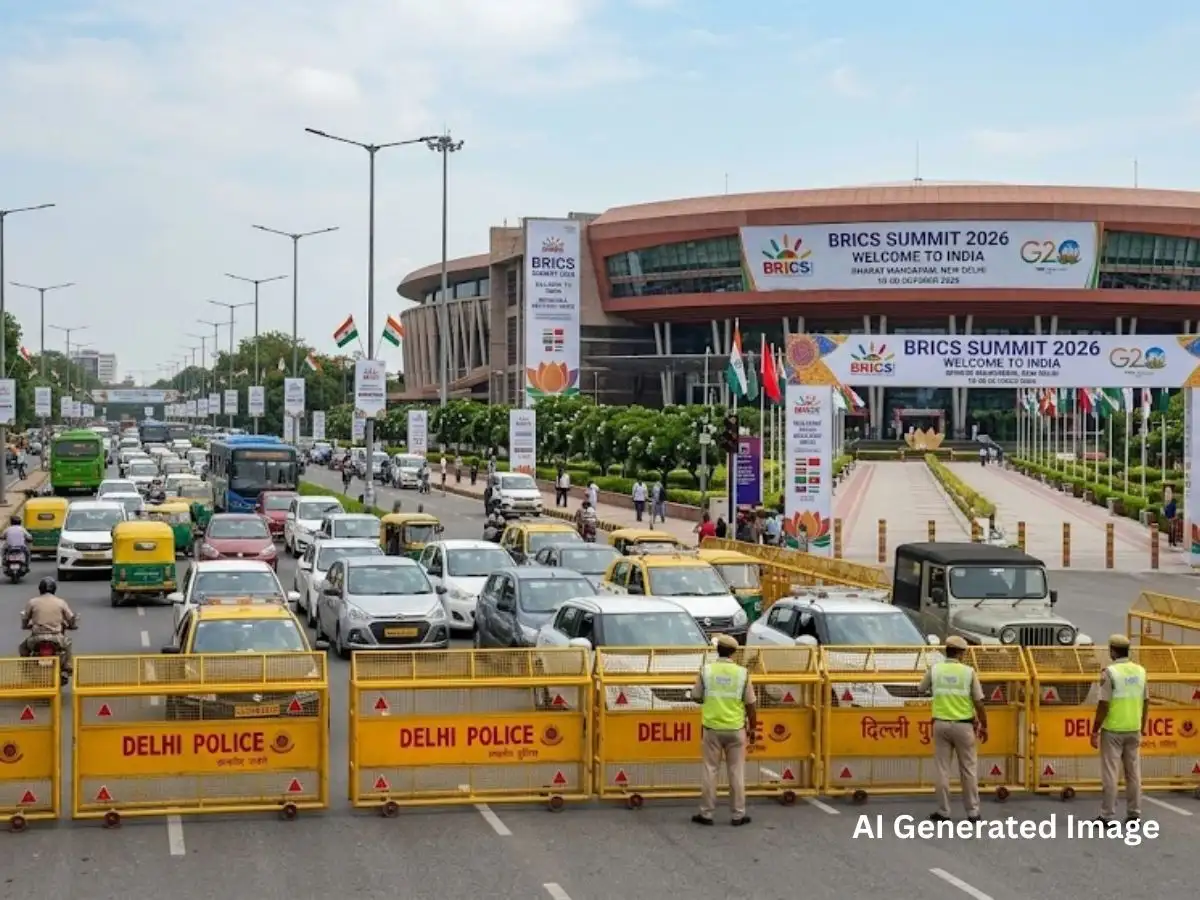
Delhi is under heightened traffic restrictions from September 11 to 13 as India hosts the 18th BRICS Leaders’ Summit. With more than 35 roads affected and 22 diversion points planned, residents, office workers and travellers will need to adjust their routes and allow extra time.
Delhi traffic restrictions begin as BRICS summit gets underway
The BRICS Summit 2026 is bringing major security and traffic changes to the national capital this weekend. The main leaders’ summit is scheduled at Bharat Mandapam in New Delhi on September 12 and 13, while traffic arrangements and security measures are in place from September 11 through September 13.
Delhi Traffic Police has issued a dedicated advisory covering controlled movement, diversions and alternate routes. More than 35 roads across important parts of the city are expected to be affected, with 22 diversion points being used to manage traffic during the movement of international dignitaries and their convoys.
The restrictions are not the same as a complete shutdown of Delhi’s roads. Instead, traffic may be regulated, diverted or temporarily stopped depending on the movement of VVIP convoys and the prevailing security situation.
For residents, the biggest impact is likely to be longer travel times, particularly around central and south Delhi and routes connecting major transport hubs.
Which roads and areas are likely to face restrictions?
Several important roads in central, south and New Delhi areas form part of the traffic management plan. These include stretches such as Sardar Patel Marg, Akbar Road, Janpath, Ashoka Road, Mathura Road, Panchsheel Marg, Satya Marg, Tolstoy Marg, Barakhamba Road and the Ranjeet Singh Flyover, among others.
The exact traffic situation can change depending on the movement of foreign leaders and security requirements. Delhi Traffic Police has specifically advised commuters to follow on-ground directions rather than relying only on their usual routes.
This is particularly important for people who regularly travel through New Delhi, India Gate, Connaught Place, Pragati Maidan and surrounding corridors.
Motorists should also expect temporary stoppages when VVIP convoys pass through designated routes. Such interruptions can create knock-on congestion even on roads that are not directly restricted.
The official Delhi Traffic Police advisory covers September 11 to 13 and asks commuters to plan ahead, allow additional travel time and follow diversion instructions.
What does it mean for office workers?
The traffic restrictions come alongside a holiday declared by the Delhi government for September 11. The official Delhi Gazette notification declares Friday, September 11, a holiday for government offices, autonomous bodies and public sector undertakings under the Delhi government because of the BRICS Summit arrangements.
Schools in Delhi have also been closed on September 11 amid the security and traffic arrangements. This is intended to reduce the number of daily trips at a time when several major roads are being regulated.
Private offices, however, should not automatically be assumed to be closed. Employees should check instructions from their employers about work-from-home arrangements, reporting times or office operations.
For those who do need to travel to work, the practical advice is simple: avoid unnecessary road journeys through affected areas and consider the Metro wherever possible.
The disruption can also affect employees who depend on app-based cabs, autos and buses because a road closure or diversion can increase journey times even when the final destination itself remains accessible.
Airport and railway passengers need extra travel time
People travelling to or from Delhi’s airport and railway stations should be particularly careful during the summit period.
Delhi Traffic Police has issued alternative-route guidance for passengers travelling to major railway stations including New Delhi, Old Delhi and Hazrat Nizamuddin. Passengers have been advised to plan their journeys in advance because traffic movement can be regulated at short notice.
For airport passengers, the Metro is being strongly recommended as a more predictable option during the restrictions. This is especially relevant for travellers who have flights at fixed times and cannot afford delays caused by road diversions.
Travellers should not calculate their journey based on normal Friday or weekend traffic. Even if the road appears clear when they leave home, a temporary VVIP movement can affect traffic further along the route.
Leaving earlier than usual and checking the latest traffic advisory before starting the journey can reduce the risk of missing a flight or train.
What about Delhi-NCR commuters from Noida?
The traffic impact extends beyond Delhi’s borders. Noida has introduced restrictions on the entry of heavy, medium and light goods vehicles into Delhi during the summit period.
Vehicles attempting to enter Delhi through the Chilla, DND and Kalindi Kunj borders are being diverted towards alternative routes including the Noida Expressway and Eastern Peripheral Expressway. Vehicles approaching Delhi from the Yamuna Expressway and Pari Chowk are also being redirected through specified alternative routes. Emergency vehicles are exempt from these restrictions.
For regular commuters from Noida, this means road conditions around the Delhi-NCR border can change significantly, particularly when additional traffic is pushed towards alternative corridors.
People travelling from Noida to central Delhi should therefore consider Metro services where practical, particularly if their destination is close to a Metro station.
Metro becomes the preferred option for many commuters
With road movement being controlled at multiple locations, public transport is expected to play an important role during the summit.
Delhi Traffic Police has repeatedly advised commuters to use the Metro wherever possible and to allow additional time for travel.
However, commuters should not interpret this as a guarantee that every Metro journey will be completely unaffected. Access around certain high-security areas can be regulated, and temporary changes may be introduced depending on security requirements.
The Delhi Metro Museum at the Supreme Court Metro station is also closed from September 11 to 13 as part of the arrangements, according to reports citing DMRC.
For most commuters, the practical approach is to use the Metro for longer cross-city journeys and walk or take a short local connection where necessary, rather than depending entirely on road transport.
Businesses and daily services may also feel the impact
Traffic restrictions do not affect only office commuters. Delivery workers, commercial drivers, shop employees, app-based cab drivers and other workers who depend on Delhi’s roads can also face longer journeys.
Businesses located along restricted corridors may experience changes in customer movement, deliveries and staff attendance.
At the same time, essential services are expected to continue. Authorities have made arrangements to ensure emergency and essential-service vehicles can move through the affected areas.
The key distinction is that the summit does not mean Delhi is completely closed. Instead, movement is being managed around specific routes and security requirements.
Residents should therefore avoid unnecessary travel through the most affected areas while continuing essential journeys with additional planning.
What commuters should do from September 11 to 13
The most important advice is to check the latest traffic advisory before leaving home. Delhi Traffic Police has warned that arrangements can change depending on VVIP movement and security requirements.
If travelling by car, keep an alternative route ready rather than relying entirely on navigation apps. A route that is normally quick may become unavailable or heavily congested during a convoy movement.
For airport and railway passengers, reaching the station or terminal early is particularly important. Metro travel can be considered where it fits the journey.
Residents should also avoid spreading unverified information about road closures or security restrictions on social media. The official Delhi Traffic Police channels remain the more reliable source for real-time traffic instructions.
The restrictions are temporary and are linked to the security requirements of hosting an international summit involving leaders and delegations from BRICS countries.
Key Takeaways
- Delhi traffic restrictions are in effect from September 11 to 13 for BRICS Summit-related security arrangements, with more than 35 roads affected and 22 diversion points planned.
- September 11 has been declared a holiday for Delhi government offices, while schools are also closed that day. Private offices should check their own work arrangements.
- Airport and railway passengers should leave early and consider the Metro, which authorities have recommended during the summit period.
- Commuters should expect temporary route changes and stoppages during VVIP movements and follow the latest Delhi Traffic Police advisories.
FAQ
When will Delhi traffic restrictions be in place for the BRICS Summit 2026?
Traffic arrangements and restrictions are planned from September 11 to September 13, 2026. The main leaders’ summit is scheduled for September 12 and 13 at Bharat Mandapam.
How many Delhi roads are affected by the BRICS Summit traffic plan?
More than 35 roads are covered by controlled traffic arrangements, while 22 diversion points have been identified as part of the traffic management plan.
Should I take the Metro during the BRICS Summit?
The Delhi Traffic Police has advised commuters to use the Metro wherever possible, particularly for journeys that could otherwise be affected by road restrictions. Airport passengers have also been specifically encouraged to consider Metro travel.
Are Delhi schools and government offices closed because of the summit?
Delhi government offices, autonomous bodies and public sector undertakings under the Delhi government have a holiday on September 11. Schools are also closed that day because of the summit-related security and traffic arrangements.







Leave a comment