

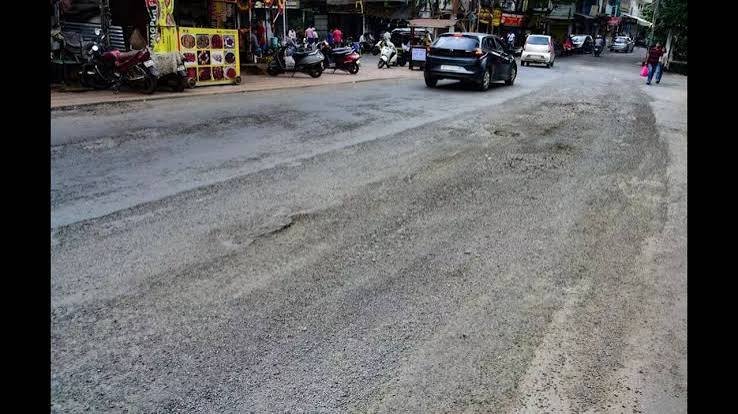
Nagpur’s pothole crisis has become more visible during Ganeshotsav as residents continue to report damaged roads, water-filled craters and unsafe stretches despite civic repair drives. The festival has increased traffic and pedestrian movement, putting renewed pressure on the city’s road infrastructure.
Nagpur potholes remain a problem during Ganeshotsav
The Nagpur pothole crisis has resurfaced as a major civic concern during Ganeshotsav, with residents in several areas saying damaged roads continue to affect daily travel. In Dabha, residents have specifically complained about the condition of the Sitabuldi-Dabha route, where NMC buses, office-goers, schoolchildren and college students travel regularly. They have also raised concerns about damaged internal roads and poor drainage.
The timing has added urgency to the issue. Ganeshotsav brings increased movement across Nagpur, with devotees travelling to mandals, markets and immersion-related facilities. Damaged roads become particularly difficult to navigate when rainwater fills potholes and reduces their visibility.
Residents in Dabha have even used the festival to draw attention to the problem, appealing to Lord Ganesha, known as Vighnaharta, to free the locality from potholes. The unusual protest reflects frustration over what residents see as delayed or inadequate road maintenance.
NMC identified 1,282 potholes before Ganeshotsav
The scale of the problem became clearer before the festival when Nagpur Municipal Corporation identified 1,282 potholes across the city. The civic body reported that these potholes covered approximately 12,380 square metres. Nagpur has a road network of around 4,587 km, including nearly 2,772 km of tar roads.
The NMC’s own figures showed considerable variation between civic zones. Dharampeth reported the highest number at 353 potholes, followed by Hanuman Nagar with 280. Nehru Nagar had 147, Laxmi Nagar 132, Ashi Nagar 125 and Mangalwari 119, according to reports on the civic survey.
The NMC had said 948 potholes were repaired by August 31 and deployed five Hot Mix Department teams for urgent work. Repairs were prioritised on roads expected to see heavy movement during Ganeshotsav, including routes connected with major processions.
Why repaired roads are still drawing complaints
The central question for residents is not simply how many potholes have been patched, but whether the repairs have made roads safer.
A report published shortly before Ganeshotsav said 819 potholes had been patched, yet roads used for Ganesh idol processions were still described as bumpy. That gap between repair numbers and the experience of commuters has become an important part of the civic debate.
Residents have also questioned whether the civic survey captured the full extent of road damage. A pothole count can change quickly after heavy rainfall, particularly when damaged asphalt expands, cracks deepen or fresh waterlogging appears.
This is especially relevant after Nagpur received around 60 mm of rain on September 12. The intense spell caused localised waterlogging in parts of the city and highlighted the connection between rainfall, drainage and road conditions.
Rain is making Nagpur’s damaged roads harder to navigate
Nagpur’s monsoon has added another layer to the pothole problem.
When rainwater collects inside a pothole, the actual depth of the damaged section becomes difficult for motorists to judge. For two-wheeler riders, sudden encounters with submerged potholes can lead to loss of control. Pedestrians also face difficulties when vehicles splash water onto already damaged footpaths and road edges.
Residents in Dabha specifically pointed to this risk, saying water-filled potholes become difficult to see during rain. They also raised concerns about elderly residents and patients who have to negotiate damaged stretches while leaving their homes.
The issue therefore goes beyond the appearance of roads. Road quality, drainage and pedestrian access are closely connected. Fixing one without addressing the others can leave the same stretch vulnerable to repeated damage.
Multiple agencies complicate road maintenance
Another reason Nagpur’s road problems can take time to resolve is that not every road is maintained by the NMC.
The city has roads and infrastructure under different agencies, including the Nagpur Improvement Trust, National Highways Authority of India, Public Works Department and Maha Metro. This division can make responsibility for repairs less straightforward, particularly when a damaged stretch connects roads managed by different authorities.
Residents, however, experience the road as one continuous network. They are less concerned about which agency owns a particular stretch and more concerned about whether it is safe to use.
This creates a coordination challenge for the civic administration. Identifying responsibility, approving repairs and completing restoration before major festivals requires communication between multiple departments and agencies.
Ganeshotsav has increased pressure on key routes
Festival traffic makes road conditions more important than usual.
Nagpur’s Ganeshotsav involves large numbers of devotees travelling to public mandals, markets and immersion facilities. The city administration has also made arrangements for artificial immersion tanks, with the NMC creating 419 such facilities across the city.
The NMC has introduced a digital platform to help citizens locate artificial immersion tanks and has deployed Nirmalya Raths for collection of floral offerings and other festival waste. These arrangements are intended to manage the environmental and logistical pressure created by the celebrations.
But these facilities also depend on road access. If approach roads are damaged, crowded or waterlogged, the efficiency of otherwise well-planned festival infrastructure can be affected.
Nagpur’s long-term road plan is much bigger
The immediate pothole repairs are only one part of a much larger road infrastructure debate in Nagpur.
The NMC’s Phase V road concretisation proposal has expanded significantly. The number of proposed roads increased from 135 to 265 following submissions from elected representatives across the city. The original proposal was estimated at around Rs 900 crore for 89.22 km of roads, although the financial requirement and road length are expected to change following the expansion.
The proposed stretches cover different parts of the city, including major corridors, residential layouts, internal roads and roads connecting important institutions.
For residents, the bigger question is whether long-term concretisation can reduce repeated pothole repairs. Cement roads can provide greater durability in some conditions, but their effectiveness also depends on proper drainage, construction quality, maintenance of utilities and planning before road work begins.
Residents want durable roads, not repeated patchwork
The latest complaints show that the public debate has shifted from simply asking for potholes to be filled to demanding better-quality roads.
In Dabha, residents have called for immediate pothole repairs, restoration of cracked cement roads and better drainage. They have also warned that damaged stretches could become accident-prone as festival traffic increases.
A separate road problem has also been reported near Jagnade Square, where ongoing flyover construction has left the road badly damaged, with broken asphalt, scattered gravel and potholes affecting commuters, patients and businesses around the area.
The pattern suggests that Nagpur’s road challenge is not limited to potholes created by monsoon rainfall. Construction activity, drainage problems, surface quality and coordination between agencies all contribute to the condition of the city’s roads.
What happens after Ganeshotsav will matter
Ganeshotsav has put Nagpur’s roads under an unusually visible spotlight, but the issue will not end with the festival.
Temporary patching can address immediate hazards, particularly on heavily used routes. However, long-term improvement requires regular road audits, timely resurfacing, effective drainage and clear responsibility for roads managed by different agencies.
The NMC’s expanded concretisation plan indicates that the administration is looking at a larger infrastructure response. The real test will be whether residents see fewer damaged stretches after the monsoon and whether newly repaired roads remain usable through the next rainy season.
For now, the experience in areas such as Dabha shows why residents remain dissatisfied. Civic repair figures may indicate progress, but the condition of roads on the ground remains the measure that commuters notice every day.
Key Takeaways
- Nagpur residents continue to report potholes and damaged roads during Ganeshotsav despite civic repair drives.
- NMC had identified 1,282 potholes before the festival and reported hundreds of repairs, but complaints continue on several busy stretches.
- Rainwater, drainage problems, construction activity and multiple road-owning agencies are complicating road maintenance.
- The NMC’s expanded Phase V concretisation plan could provide a longer-term response, but construction quality and drainage will remain critical.
FAQs
Why are Nagpur residents complaining about potholes during Ganeshotsav?
Residents say several roads remain damaged despite repair drives. Festival traffic has increased movement on these stretches, while rainfall can fill potholes with water and make them difficult to identify, particularly for two-wheeler riders.
How many potholes did NMC identify in Nagpur?
The NMC identified 1,282 potholes across Nagpur before Ganeshotsav. The civic survey estimated that they covered around 12,380 square metres. The NMC subsequently reported that 948 had been repaired by August 31.
Why does rain make Nagpur’s pothole problem worse?
Rainwater can collect in damaged sections of roads, making potholes harder to see and increasing risks for motorists and pedestrians. Heavy rain can also worsen cracks and contribute to further road deterioration where drainage is inadequate.
Is Nagpur planning a long-term solution for damaged roads?
The NMC is pursuing a larger road concretisation programme. Under Phase V, the proposed number of roads increased from 135 to 265, with the original proposal estimated at around Rs 900 crore for 89.22 km.
(Nagpur pothole crisis, Nagpur roads, Nagpur potholes 2026, Ganeshotsav Nagpur 2026, Nagpur Municipal Corporation, NMC road repairs, Nagpur road conditions, Nagpur monsoon potholes, Nagpur traffic, Nagpur civic issues, Nagpur Ganesh festival, Nagpur road concretisation)






Leave a comment