

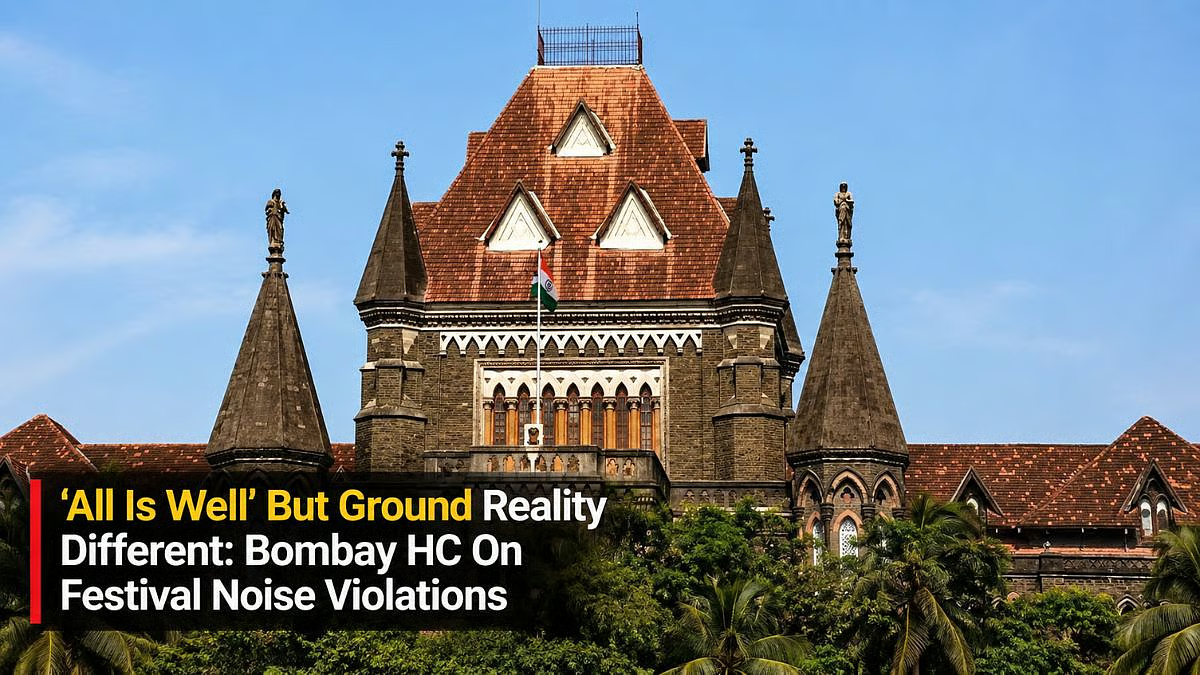
Maharashtra festival noise rules have come under stricter enforcement after the Bombay High Court issued directions on September 22, 2026, covering firecrackers, loud sound systems, laser lights, decibel monitoring and organiser accountability during festive processions across the state.
Bombay High Court steps in over festival noise
The issue became particularly prominent during the ongoing Ganeshotsav season, with concerns over loudspeakers, amplified music, DJs and firecrackers used during public celebrations and processions.
On September 21, the Bombay High Court took suo motu cognisance of noise and air pollution during festivals. The bench of Justice Girish S. Kulkarni and Justice Neela K. Gokhale questioned the enforcement of existing noise pollution regulations and sought details from the Maharashtra government on the steps being taken.
The court subsequently issued directions on September 22 aimed at making existing rules more enforceable during festivals. The order applies to festive celebrations and processions across Maharashtra rather than targeting one particular festival or community.
The development is significant for cities such as Mumbai, Pune, Thane, Nashik and Nagpur, where large public processions frequently pass through densely populated residential and commercial areas.
Firecrackers banned on public streets during festivities
One of the clearest changes is the complete prohibition on bursting firecrackers on public streets and roads during festivities.
The court directed authorities to take steps to prevent firecrackers from being used in public processions and celebrations on roads. The direction is linked to concerns about both noise and air pollution, particularly in densely populated urban areas.
This does not mean that every use of firecrackers in every possible location has been addressed in exactly the same way. The specific High Court direction concerns bursting firecrackers on public streets and roads during festivities.
For organisers, the practical implication is that firecrackers cannot simply be treated as part of a procession because the event has received other permissions.
Laser lights and high-intensity beams also restricted
The High Court has also prohibited laser lights, high-intensity lumen lights and beams during festive celebrations and processions.
Such lighting systems have increasingly become part of large public events, particularly processions where powerful lights are combined with amplified sound. The court’s directions place these systems within the broader effort to control risks and disturbances associated with public celebrations.
In Pune, police have separately reiterated restrictions on high-intensity sound and lighting equipment during Ganesh immersion processions. These include pressure-mid sound systems, plasma lights and high-intensity laser lights.
Decibel meters become central to enforcement
The new directions put greater emphasis on measuring noise rather than relying only on complaints after an event.
Organisers seeking permission for sound systems have been directed to install visible decibel measurement meters at venues and during processions. Authorities are expected to measure and record noise levels and take action when permitted limits are breached.
Organisers must also provide an undertaking that the sound systems being used have internal sound limiters.
This distinction matters because permission to use a loudspeaker does not mean permission to exceed the legally prescribed noise limits. The Noise Pollution (Regulation and Control) Rules, 2000 continue to apply during festivals. The High Court has specifically emphasised that festive celebrations do not make these rules disappear or automatically relax them.
Organisers face greater financial accountability
Another important feature of the High Court’s directions is the proposed use of security deposits as a condition for permissions.
The court directed authorities to consider accepting a security deposit of at least ₹1 lakh from associations or groups and ₹50,000 from individuals seeking permissions under the Noise Pollution Rules. The amount can be forfeited if the prescribed decibel limits are breached.
The approach shifts some responsibility directly onto event organisers.
Instead of relying only on penalties after a violation, the system creates a financial consequence connected to compliance. Authorities have also been directed to seize and confiscate equipment found to be involved in violations.
Permissions and organiser details must be visible
The directions also increase transparency around public processions.
Written permissions must be displayed during processions, along with details of the people responsible for organising them. This includes names, addresses and mobile numbers, allowing authorities to identify those responsible if violations occur.
Authorities have also been directed to consider the cumulative noise impact when multiple permissions are granted within the same ward.
This is particularly relevant in large cities where several processions or public events may take place in nearby areas at the same time. A single event may comply with its individual limits, while several events operating simultaneously can create a substantially higher overall noise level.
Pune records 71 noise pollution cases
The issue is already visible on the ground in Pune.
As of September 24, Pune and Pimpri-Chinchwad police had registered a combined 71 cases for violations of noise pollution norms during this year’s Ganesh festival. Pune Police recorded 21 cases, while Pimpri-Chinchwad Police recorded 50.
Pune Police also deployed 120 teams equipped with decibel meters to monitor noise levels.
The police have imposed restrictions on high-intensity sound and lighting equipment and have placed limits on the duration of dhol-tasha performances at road intersections. According to police, each troupe can perform for a maximum of 15 minutes at an intersection, including preparation time, while prescribed decibel limits continue to apply.
These measures show how enforcement is moving toward active monitoring rather than depending solely on citizen complaints.
What the new rules mean for Maharashtra cities
For residents, the immediate change is greater emphasis on controlled sound, visible monitoring and enforcement during public festivities.
For mandals, procession organisers and event groups, permissions now come with greater compliance responsibilities. Sound systems need appropriate controls, noise levels can be measured, violating equipment can be seized and security deposits may be forfeited where the conditions specified by authorities are breached.
The issue is especially relevant to Tier-2 cities and growing urban centres. Festivals in cities such as Nagpur, Nashik, Kolhapur, Solapur, Aurangabad and other parts of Maharashtra often involve large public gatherings and processions.
The High Court’s directions require the state’s enforcement machinery to apply the legal framework more consistently across these celebrations.
The matter has been adjourned for compliance to October 15, 2026. This means the implementation of the directions and the response of state and local authorities will remain an important issue through the upcoming festive period.
Takeaways
- The Bombay High Court has banned bursting firecrackers on public streets and roads during festivities across Maharashtra.
- Laser lights, high-intensity lumen lights and beams have also been prohibited during festive celebrations and processions.
- Organisers using permitted sound systems face stricter monitoring through decibel meters, internal sound limiters and recorded noise levels.
- Security deposits of at least ₹1 lakh for groups and ₹50,000 for individuals may be required, with forfeiture possible for decibel-limit violations.
FAQs
What are the new Maharashtra festival noise rules?
The Bombay High Court has directed stricter enforcement of noise pollution rules during festivals, including decibel monitoring, restrictions on high-intensity lighting, a ban on firecrackers on public streets and stronger action against unauthorised sound systems.
Are loudspeakers completely banned during festivals in Maharashtra?
The court’s directions do not amount to a blanket ban on every permitted sound system at every festival venue. Permitted sound systems remain subject to applicable noise limits, permissions, monitoring and enforcement requirements. Organisers must also ensure sound systems have internal limiters.
Is bursting firecrackers completely banned across Maharashtra?
The High Court has ordered a complete ban on bursting firecrackers on public streets and roads during festivities. The direction specifically addresses public roads and streets during festive celebrations.
What happens if festival organisers violate noise limits?
Authorities have been directed to take strict action, including seizure and confiscation of offending sound equipment. A security deposit may also be forfeited when prescribed decibel limits are breached, alongside other legal action applicable to the violation.








Leave a comment