

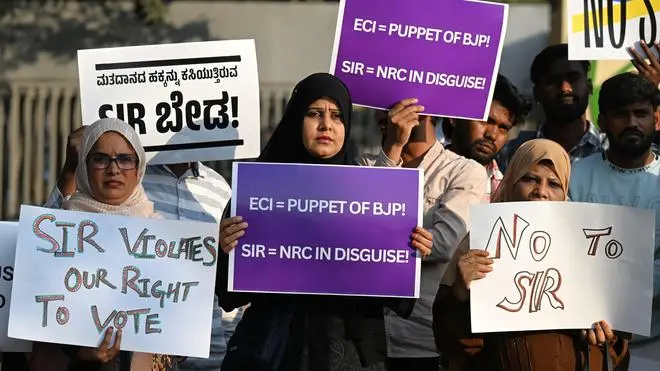
India’s Special Intensive Revision (SIR) of electoral rolls has become a major political and administrative issue, raising questions about voter registration, documentation and the accuracy of electoral lists. For ordinary citizens, the process highlights the importance of checking voter details, responding to official notices and ensuring that eligible voters are not left out.
What Is the Special Intensive Revision of Electoral Rolls?
The Special Intensive Revision, commonly known as SIR, is a voter-list verification exercise conducted by the Election Commission of India (ECI). Its purpose is to review electoral rolls, verify voter information and improve the accuracy of records before elections.
Electoral rolls contain the names of eligible voters registered in a particular constituency. These lists are essential for conducting elections because only people whose names appear on the relevant electoral roll can ordinarily cast their votes in that constituency.
During an intensive revision, election officials may undertake detailed verification, including checking existing entries and identifying people who have moved, died or appear more than once in the records. The process also aims to identify eligible citizens whose names may be missing.
However, the accuracy of the exercise depends on how verification is conducted, how records are updated and whether eligible voters have a reasonable opportunity to correct errors or challenge decisions.
Why Has the SIR Process Become a National Debate?
The debate around SIR has intensified because of concerns over voter deletions, documentation requirements and the transparency of electoral administration. Opposition parties and civil society groups have questioned whether the exercise could exclude eligible voters, while the Election Commission maintains that accurate electoral rolls are necessary for credible elections.
Recent protests in several cities have brought these disagreements into the public spotlight. The controversy has also reached the Supreme Court, where questions concerning the Election Commission’s procedures and certain changes to voter-registration forms have received judicial scrutiny.
The central issue is not whether electoral rolls should be accurate. There is broad agreement that deceased voters, duplicate entries and outdated records should be addressed. The disagreement concerns how this should be achieved without depriving eligible citizens of their right to participate in elections.
For ordinary voters, this distinction matters. A revision exercise intended to improve the quality of electoral records must also provide accessible procedures for people to verify their details, respond to notices and seek corrections.
What Is Happening in Maharashtra?
Maharashtra provides a recent example of why electoral-roll accuracy matters. According to reporting published on October 9, 2026, the state’s draft electoral roll released on August 31 contained a technical error that incorrectly displayed the ages of 2,70,313 voters as between 101 and 150 years.
The discrepancy was attributed to a technical problem that recorded their birth years as 1900. The issue was corrected on October 6, following efforts by the Maharashtra Chief Electoral Officer to resolve the problem with the Election Commission’s central system.
The incident demonstrates how technical errors can affect large numbers of voters even when the underlying problem is administrative rather than related to eligibility.
Maharashtra’s draft roll also recorded approximately 7.72 crore electors, compared with 9.79 crore before the SIR exercise. The difference requires careful interpretation because the revision involves multiple categories of entries, including people reported as deceased, shifted, absent, untraceable or duplicated. A reduction in the draft roll should not automatically be treated as proof that every removed entry was either valid or invalid.
The claims-and-objections period for the Maharashtra draft roll was reported to remain open until October 12, 2026, with the final roll scheduled for publication on November 16. Voters should check the latest instructions issued by the state election authorities because deadlines and procedures can vary by revision stage.
How Can SIR Affect Ordinary Voters?
The impact of SIR depends on an individual’s circumstances and the accuracy of the information recorded in the electoral roll.
For voters who have lived at the same address for years, the exercise may simply involve checking that their names and details remain correct. Others may need to take additional steps if their entries contain errors or cannot be verified.
People who have moved to another city for employment, education or family reasons should pay particular attention to their registration details. A person may be living in a different location from the one recorded in the electoral roll, making it important to follow the prescribed process for updating registration.
Young adults who have recently become eligible to vote should also verify whether their names have been included. Similarly, families should not assume that every member’s registration status is identical simply because they share the same address.
In some cases, a voter may discover that their name is missing from a draft list. This does not mean they should ignore the issue or assume that it will automatically be resolved. They should contact the appropriate election authorities and follow the applicable procedure for inclusion or correction.
The practical lesson is straightforward: voters should verify their own records rather than relying only on information shared by neighbours, political representatives or social media accounts.
What Should Voters Do If Their Names Are Missing?
Voters can use the Election Commission’s official voter-services portal to search electoral rolls and access registration services. The portal also provides facilities associated with the SIR process, including searching previous revision records and responding to certain official notices.
If a name is missing or the details appear incorrect, citizens should first establish what the current electoral roll shows. They should then identify the applicable process for their state and revision stage.
Depending on the circumstances, voters may need to submit an application for inclusion, request a correction or respond to a notice issued by election officials. The relevant forms and supporting documents depend on the nature of the application and the instructions applicable at that time.
Citizens should keep copies of applications, acknowledgements and official communications. These records can be useful when following up on a pending request or seeking clarification from the Electoral Registration Officer.
If an application is rejected or a name is excluded, voters should ask for the applicable reason and information about the available remedy or appeal process. They should not assume that submitting a form automatically guarantees inclusion.
Most importantly, voters should avoid sharing sensitive identity documents with unofficial websites or unknown individuals claiming to provide registration assistance. Official election portals and authorised election personnel are the safer channels for handling personal information.
Why Documentation and Transparency Matter
Documentation is an important part of electoral administration, but the process must remain understandable and accessible to eligible citizens.
People in rural areas, small towns and Tier-2 cities may face practical difficulties when dealing with official procedures. These can include limited internet access, long travel distances to administrative offices, language barriers or uncertainty about which documents are required.
Older citizens, migrant workers and people with disabilities may need additional assistance to complete verification procedures. Clear communication from election authorities can help reduce confusion and prevent avoidable errors.
Transparency is equally important. When entries are removed or applications are rejected, voters should have access to the applicable reasons and a meaningful opportunity to challenge mistakes. Election officials also need reliable systems for updating information and resolving technical problems.
Political parties and civil society organisations can help by spreading accurate information and directing citizens towards official services. However, claims about mass deletions, irregularities or political bias should be assessed using verifiable evidence rather than unconfirmed social media posts.
A credible electoral process requires both accurate records and safeguards that protect eligible voters from administrative mistakes.
What the SIR Debate Means for India’s Democracy
The SIR debate raises a broader question about how India can maintain accurate voter lists while protecting democratic participation.
An electoral roll must be reliable enough to prevent duplicate or ineligible entries, but its verification process must also avoid excluding citizens who meet the legal requirements to vote. These objectives should reinforce each other rather than become competing priorities.
The controversy also highlights the importance of accessible grievance mechanisms. Citizens need clear information about deadlines, required documents, correction procedures and the authorities responsible for resolving disputes.
Judicial scrutiny and public debate can contribute to accountability, but conclusions about the legality of specific procedures should depend on the applicable law and the outcome of relevant proceedings.
For voters, the immediate priority is practical rather than political. Checking registration details, responding to official notices and keeping records of applications can help address problems before an election.
The effectiveness of SIR will ultimately depend not only on how many entries are reviewed, but also on whether the resulting electoral rolls are accurate, transparent and inclusive.
Key Takeaways
- The Special Intensive Revision is intended to verify electoral records and improve the accuracy of voter lists.
- The SIR debate centres on voter deletions, documentation, administrative transparency and safeguards against wrongful exclusion.
- Voters should check their registration details through official Election Commission services and respond promptly to applicable notices.
- If a name is missing or an application is rejected, citizens should seek clarification and follow the prescribed correction or appeal process.
Frequently Asked Questions
1. What does SIR stand for in elections?
SIR stands for Special Intensive Revision. It is an exercise to review and verify electoral rolls, with the aim of maintaining accurate voter records.
2. Can a voter lose the right to vote if their name is missing from the electoral roll?
A person whose name is absent from the relevant electoral roll generally cannot cast a vote in that constituency. Eligible citizens should contact election officials and follow the applicable process for inclusion or correction before the relevant deadline.
3. How can I check whether my name is on the voter list?
Visit the Election Commission of India’s official voter-services portal at voters.eci.gov.in and use the available electoral-roll search facility. You can also contact your local election office for assistance.
4. What should I do if my name is missing from the draft electoral roll?
Check the applicable revision instructions and submit the prescribed application or representation within the relevant deadline. Keep the acknowledgement and any supporting documents, and follow up with the Electoral Registration Officer if necessary.








Leave a comment