

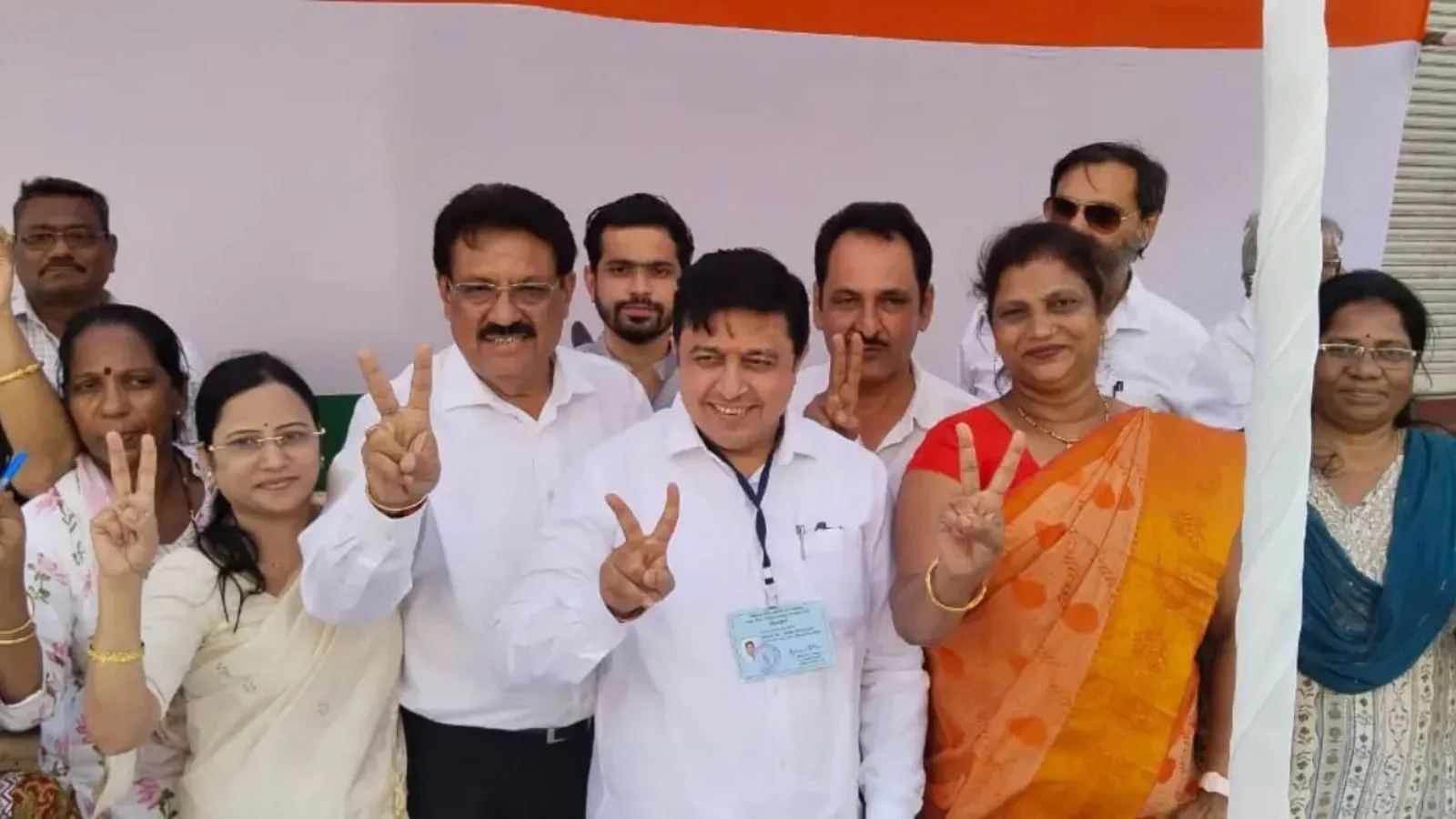
Congress leader Abhijeet Wanjari has retained the Nagpur Division Graduates’ constituency in the Maharashtra Legislative Council elections, defeating BJP candidate Sudhakar Kohale by 3,271 votes. The closely contested result is a setback for the BJP in its traditional political stronghold.
Abhijeet Wanjari Defeats BJP’s Sudhakar Kohale in Nagpur
Congress candidate and sitting MLC Abhijeet Wanjari has won the Nagpur Division Graduates’ constituency in the Maharashtra Legislative Council (MLC) elections held in October 2026. He defeated BJP candidate and former MLA Sudhakar Kohale by 3,271 votes, retaining the seat for another term.
According to the final counting figures, Wanjari secured 67,231 votes, while Kohale received 63,960 votes. The result was declared in the early hours of October 29 after an unusually long counting process that continued for more than 40 hours.
The contest attracted considerable political attention because Nagpur is the home city of Maharashtra Chief Minister Devendra Fadnavis and Union Minister Nitin Gadkari. Both BJP leaders had campaigned for Kohale.
Wanjari’s victory is significant for Congress because the party managed to retain a constituency where the BJP has traditionally enjoyed considerable political influence.
Nagpur MLC Election Counting Continued for Over 40 Hours
The counting process for the Nagpur Graduates’ constituency began at 8 am on October 27 at the Divisional Sports Complex in Mankapur, Nagpur.
A total of 84 tables were arranged for counting, with election officials overseeing the process. Unlike a straightforward first-past-the-post election, the graduates’ constituency election followed the preferential voting system used for Legislative Council elections.
Under this system, voters can mark their preferences for candidates. If no candidate reaches the required quota through first-preference votes, the counting process moves to the transfer and elimination of candidates based on subsequent preferences.
This procedure made the Nagpur contest particularly competitive. Neither Wanjari nor Kohale managed to reach the prescribed winning quota during the initial counting rounds.
As a result, officials continued with the second-preference counting and elimination process before declaring the final winner.
The prolonged counting attracted attention across Maharashtra, with political parties and supporters closely following the changing vote positions.
BJP Candidate Initially Took the Lead in First-Preference Counting
The Nagpur MLC election witnessed a close contest, with the BJP candidate initially holding an advantage during the counting process.
After the second round of first-preference counting, Sudhakar Kohale had secured 60,924 votes, while Abhijeet Wanjari had received 56,630 votes.
This gave Kohale a lead of 4,294 votes over the Congress candidate. Independent candidate Nitesh Karale had also emerged as an important contender, receiving 24,249 first-preference votes.
However, the initial lead did not guarantee victory because no candidate had secured the required quota of 75,438 votes.
The counting therefore proceeded according to the preferential voting system. During the subsequent elimination rounds, votes were transferred based on the preferences marked by voters.
Wanjari eventually moved ahead and finished with 67,231 votes, compared with Kohale’s 63,960.
The final margin of 3,271 votes highlighted how competitive the election had become.
Why the Nagpur MLC Result Matters for BJP
The defeat has political significance because Nagpur has long been considered an important centre of BJP influence in Maharashtra.
The city is not only the political home of Chief Minister Devendra Fadnavis but also the parliamentary constituency represented by Union Minister Nitin Gadkari. The Rashtriya Swayamsevak Sangh headquarters is also located in Nagpur, adding to the city’s wider political importance.
BJP had fielded Sudhakar Kohale, a former MLA, against the sitting Congress MLC. The party’s campaign received attention because of the involvement of senior leaders.
However, the result shows that a strong political presence in a region does not automatically translate into victory in every election.
The Nagpur Graduates’ constituency has a different electorate from regular Assembly or Lok Sabha constituencies. Only eligible registered graduates can participate, making voter registration, professional concerns and constituency-level engagement important factors.
The result also gives opposition parties an opportunity to question the BJP’s political strategy in a region it considers important.
However, the election outcome alone does not establish a broader change in voter preferences across Nagpur or Maharashtra.
Congress Retains Nagpur Seat for Second Consecutive Term
The victory also marks another electoral success for Abhijeet Wanjari in the Nagpur Graduates’ constituency.
In the previous election, Wanjari had defeated BJP candidate Sandip Joshi to win the seat. His latest victory against Sudhakar Kohale means Congress has retained the constituency for a second consecutive term.
The result gives Wanjari another opportunity to represent graduates from the Nagpur division in the Maharashtra Legislative Council.
Graduates’ constituencies are intended to provide representation to eligible graduate voters in the state legislature. Their representatives can raise issues related to education, employment, professional opportunities and other public concerns.
For Congress, retaining the seat is important because it demonstrates that the party continues to have electoral support among sections of the electorate in the Nagpur region.
Wanjari’s second consecutive victory also strengthens his position within the party’s local political organisation.
MVA Wins Three of Five Maharashtra MLC Seats
The Nagpur result was part of a larger set of Maharashtra Legislative Council elections held across five constituencies on October 23, 2026.
The opposition Maha Vikas Aghadi (MVA) secured three of the five seats, while the ruling Mahayuti alliance won two.
The results were as follows:
- Nagpur Graduates’ constituency: Abhijeet Wanjari of Congress defeated BJP’s Sudhakar Kohale.
- Pune Graduates’ constituency: Harshada Deshmukh of the NCP (Sharadchandra Pawar) defeated BJP’s Smita Jadhav.
- Chhatrapati Sambhajinagar Graduates’ constituency: Pratapsinh Patil of the NCP (Sharadchandra Pawar) defeated sitting MLC Satish Chavan.
- Pune Teachers’ constituency: BJP secured the seat.
- Amravati Teachers’ constituency: Eknath Shinde-led Shiv Sena retained the seat.
The outcome was a setback for the BJP-led Mahayuti in the graduates’ constituencies, particularly in Nagpur and Pune.
For the opposition MVA, winning three seats provided an opportunity to highlight its performance in a state where the ruling alliance holds power.
The results also brought attention to differences between voting patterns in graduates’ and teachers’ constituencies and those seen in regular state elections.
What the Nagpur Election Result Means for Graduates
Beyond the political competition, the result raises questions about the expectations of graduate voters in the Nagpur division.
Graduates’ constituencies provide an opportunity for educated voters to elect representatives to the Legislative Council. Issues such as employment opportunities, recruitment processes, higher education, skill development and professional growth can become important subjects for these representatives.
Nagpur and the surrounding districts have a large population of students and young professionals. Their concerns include access to quality education, competitive examination preparation, government recruitment and private-sector employment.
The elected MLC can raise these issues in the Maharashtra Legislative Council and seek government attention through legislative proceedings.
Wanjari’s victory means he will continue representing the constituency. Voters will now expect him to address the concerns that influenced their participation in the election.
At the same time, the BJP will need to examine its performance and understand why its candidate could not retain the seat despite the involvement of senior leaders.
The result is an important local political development, but its longer-term implications will depend on how both parties respond in future elections.
Key Takeaways
- Congress’s Abhijeet Wanjari defeated BJP candidate Sudhakar Kohale by 3,271 votes to retain the Nagpur Graduates’ constituency.
- Wanjari secured 67,231 votes, while Kohale received 63,960 votes after more than 40 hours of counting.
- The election involved preferential voting, and neither candidate initially reached the required winning quota.
- The Maha Vikas Aghadi won three of the five Maharashtra MLC seats, while the Mahayuti secured two.
Frequently Asked Questions (FAQs)
1. Who won the Nagpur MLC election in October 2026?
Congress candidate and sitting MLC Abhijeet Wanjari won the Nagpur Division Graduates’ constituency, defeating BJP candidate Sudhakar Kohale.
2. By how many votes did Abhijeet Wanjari defeat Sudhakar Kohale?
Wanjari defeated Kohale by 3,271 votes. Wanjari received 67,231 votes, while Kohale secured 63,960.
3. Why did Nagpur MLC vote counting take more than 40 hours?
The election followed a preferential voting system. Since no candidate reached the required quota through first-preference votes, officials had to conduct additional counting and candidate elimination rounds based on voters’ subsequent preferences.
4. How many seats did the Maha Vikas Aghadi win in the Maharashtra MLC elections?
The Maha Vikas Aghadi won three of the five seats contested in the October 2026 Maharashtra MLC elections. The ruling Mahayuti alliance secured the remaining two seats.









Leave a comment