

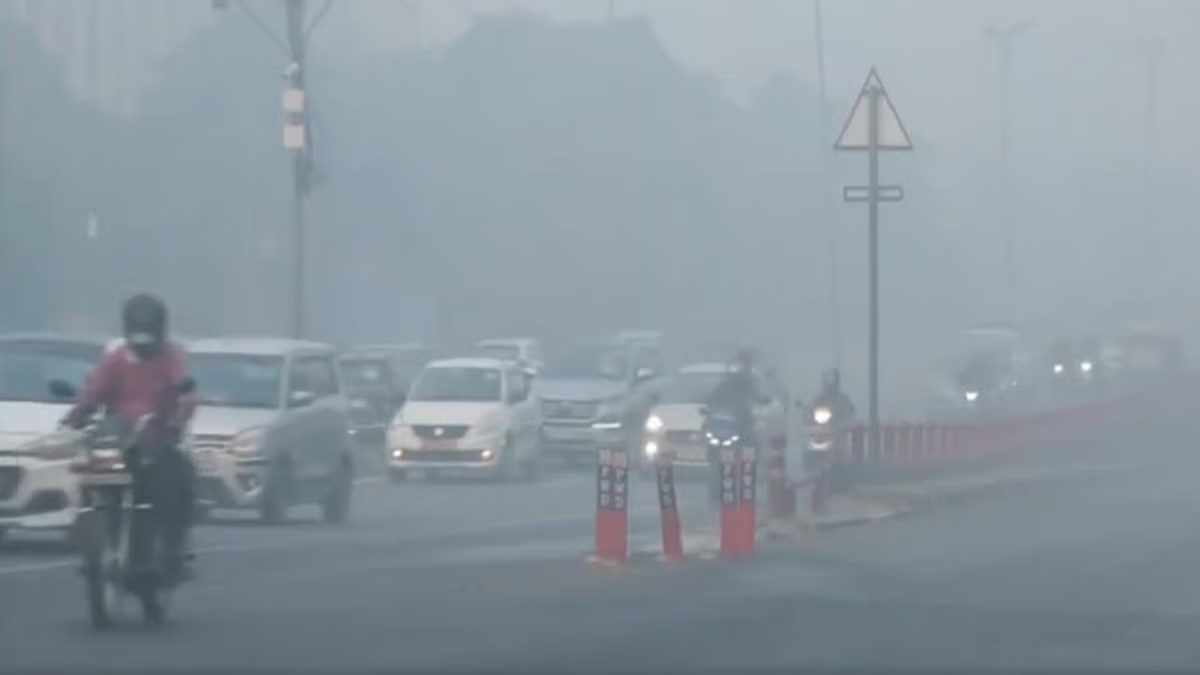
Delhi’s air pollution continues to affect residents as winter conditions contribute to unhealthy air quality across the National Capital Region (NCR). On November 25, 2026, the city’s AQI stood at 224 in the latest available update, while GRAP Stage II measures remained active. Residents should understand the restrictions, transport advisories and precautions currently in place.
Delhi AQI Today: Air Quality Remains in Poor Category
Delhi’s air quality remained in the Poor category on November 25, according to the Central Pollution Control Board (CPCB) data displayed on the Commission for Air Quality Management (CAQM) website.
The latest available CAQM dashboard update at 1 pm recorded Delhi’s AQI at 224. An earlier update at 7 am had recorded an AQI of 228.
Under India’s Air Quality Index classification, a reading between 201 and 300 falls under the Poor category. This means pollution levels remain a concern, particularly for people with respiratory conditions, children and older adults.
The situation is also influenced by seasonal weather conditions. During winter, low wind speeds, temperature-related atmospheric changes and limited vertical mixing can prevent pollutants from dispersing effectively.
As a result, emissions from vehicles, construction activities, industries and other sources can contribute to the accumulation of pollutants near the ground.
GRAP Stage II Remains Active Across Delhi-NCR
The Commission for Air Quality Management (CAQM) is responsible for implementing the Graded Response Action Plan (GRAP) across Delhi-NCR.
GRAP is a structured system that introduces additional pollution-control measures as air quality deteriorates. Its revised September 2026 schedule contains four stages based on Delhi’s AQI.
The categories are:
- Stage I: Poor, AQI between 201 and 300.
- Stage II: Very Poor, AQI between 301 and 400.
- Stage III: Severe, AQI between 401 and 450.
- Stage IV: Severe Plus, AQI above 450.
The CAQM invoked Stage II across Delhi-NCR on November 2 after Delhi’s AQI reached 324. Stage III was subsequently introduced on November 6 when pollution levels and forecasts indicated further deterioration.
However, following an improvement in air quality, CAQM revoked Stage III on November 17.
Stage I and Stage II measures continue to remain in force, according to the latest CAQM dashboard. The distinction is important: the current AQI reading of 224 falls under the Poor category, but the previously invoked Stage II measures have not been formally withdrawn.
The authorities continue monitoring pollution levels and weather forecasts before deciding whether additional restrictions are necessary.
What GRAP Stage II Restrictions Mean for Residents
GRAP Stage II introduces additional measures beyond the pollution-control actions already required under Stage I.
These restrictions primarily target road dust, construction pollution, private vehicle usage and administrative measures.
Some of the important measures include:
1. Mechanical road cleaning and water sprinkling
Municipal authorities are required to increase mechanical and vacuum-based road sweeping. Water sprinkling and dust suppressants must also be used, particularly on roads with heavy traffic.
These measures aim to reduce dust particles becoming airborne.
2. Higher parking charges
Authorities may increase parking fees to discourage unnecessary use of private vehicles.
The objective is to encourage commuters to consider public transport and reduce traffic-related emissions.
3. Increased inspections at construction sites
Pollution-control authorities are required to intensify inspections at construction and demolition sites.
Developers and construction agencies must follow prescribed dust-control measures. Violations can attract enforcement action.
4. Staggered office timings
Government authorities are required to consider staggered working hours for public offices and municipal bodies in Delhi and specified NCR districts, including Gurugram, Faridabad, Ghaziabad and Gautam Buddha Nagar.
The Central Government may also decide on staggered timings for its offices.
5. Electric heaters for residential staff
Resident Welfare Associations (RWAs) are required to provide electric heaters, along with suitable electricity arrangements, for security guards, sanitation workers, horticulture staff and other support employees.
This measure aims to discourage the burning of biomass and municipal waste for warmth during winter.
These measures are intended to reduce pollution sources while limiting unnecessary travel and dust generation.
Are Schools Closed Under Current GRAP Restrictions?
One of the common concerns among parents is whether worsening air quality will result in school closures or online classes.
As of November 25, Stage III restrictions have been revoked. The hybrid-class provision for students up to Class V is listed under Stage III of the revised GRAP schedule, not Stage II.
The Delhi Directorate of Education had also issued a circular on November 17 directing schools to resume normal physical classes following the withdrawal of Stage III restrictions.
Therefore, Stage II alone does not require schools to shift to online or hybrid classes.
However, schools and parents should continue monitoring official advisories because additional decisions can be taken if air quality deteriorates.
Are Work From Home Rules Mandatory for Delhi Offices?
The continuation of GRAP Stage II does not automatically mean that private companies must shift employees to work from home.
The current framework encourages offices to consider staggered timings and unified commuting arrangements to reduce congestion.
The earlier November 5 to November 20 precautionary order had directed state and private offices to operate with up to 50% physical attendance in specified areas. That period has ended.
The November 17 CAQM order revoked Stage III but retained the restrictions on dust-generating demolition and outdoor construction activities under the October 30 order.
Residents should therefore distinguish between temporary administrative directions and measures that remain active under the current GRAP framework.
Companies can consider flexible working arrangements, but employees should not assume that a blanket work-from-home requirement is currently in force.
Vehicle Restrictions and Public Transport Advisory
Vehicle emissions remain an important part of Delhi’s air pollution challenge.
Under Stage I and Stage II measures, authorities are expected to enforce pollution-under-control (PUC) requirements and take action against visibly polluting vehicles.
The revised GRAP framework also requires enforcement of existing restrictions on overage petrol and diesel vehicles.
However, the stricter restrictions on BS-III petrol and BS-IV diesel four-wheelers listed under Stage III should not be confused with the current Stage II measures.
Residents can reduce their contribution to traffic pollution by following these precautions:
- Prefer Delhi Metro, buses and other public transport options.
- Consider carpooling for regular office journeys.
- Keep vehicle engines properly maintained.
- Maintain correct tyre pressure.
- Renew PUC certificates before expiry.
- Switch off engines while waiting at traffic signals.
- Avoid unnecessary private vehicle journeys.
The CAQM has also encouraged authorities to increase the availability and frequency of public transport services, including electric and CNG buses, Metro and RRTS services.
How Delhi Residents Can Protect Themselves From Air Pollution
Poor air quality can affect daily routines, especially for people who spend long periods outdoors.
Children, older adults and people with asthma or existing respiratory and cardiovascular conditions should take particular care during periods of elevated pollution.
Residents can follow these practical precautions:
Limit prolonged outdoor activities: Avoid unnecessary outdoor exercise near busy roads, particularly when pollution levels are elevated.
Check AQI before stepping outside: Use the SAMEER application or official CPCB updates to understand local air quality.
Follow medical advice: People with respiratory conditions should follow their prescribed treatment plans and consult healthcare professionals if symptoms worsen.
Reduce indoor pollution: Avoid smoking, burning incense excessively or using other smoke-producing materials in poorly ventilated spaces.
Keep indoor spaces clean: Regular cleaning can help reduce accumulated dust.
Residents should also remember that an ordinary face covering does not necessarily provide adequate protection against fine particulate pollution. A properly fitted particulate respirator, such as an N95, offers better filtration when outdoor exposure cannot be avoided.
People experiencing breathing difficulty, chest discomfort or persistent respiratory symptoms should seek medical attention.
Why Delhi’s Winter Pollution Becomes a Recurring Problem
Delhi’s winter pollution is influenced by several interconnected factors.
Vehicle emissions, industrial activity, construction dust, road dust, waste burning and seasonal agricultural residue burning all contribute to the pollution load.
Weather conditions can make the situation worse. During colder months, weak winds and a shallow atmospheric boundary layer can restrict the movement and dispersion of pollutants.
This allows particulate matter and other pollutants to accumulate near the surface.
The problem also extends beyond Delhi’s municipal boundaries. Pollution sources across neighbouring districts and states contribute to the wider NCR air quality situation.
This is why CAQM coordinates pollution-control measures across Delhi, Haryana, Uttar Pradesh and Rajasthan.
The Commission’s revised GRAP framework also places responsibilities on municipal bodies, traffic police, pollution-control boards, industries and construction agencies.
Long-term improvement will require consistent action on public transport, cleaner industrial operations, waste management, road dust and construction practices rather than relying only on emergency restrictions during winter.
What Residents Should Expect in the Coming Days
Delhi’s AQI remained in the Poor category on November 25, while Stage II continued to be listed as active on the CAQM dashboard.
The Commission is monitoring daily pollution readings alongside forecasts from the India Meteorological Department (IMD) and the Indian Institute of Tropical Meteorology (IITM).
If pollution levels are expected to deteriorate further, authorities can introduce additional restrictions under Stage III or Stage IV.
If air quality improves consistently, the Commission can also withdraw existing measures through an official order.
For now, residents should follow the Stage I and Stage II advisories, use public transport where practical and avoid activities that generate unnecessary dust or smoke.
The coming winter weeks will be important in determining whether Delhi can maintain improved air quality or faces another period of severe pollution.
Key Takeaways
- Delhi recorded an AQI of 224 at 1 pm on November 25, 2026, placing the city in the Poor category.
- GRAP Stage II remains active across Delhi-NCR, even though the latest AQI reading is below the Stage II threshold.
- Current measures include enhanced road cleaning, water sprinkling, construction-site inspections, higher parking charges and staggered office timings.
- Stage III restrictions were revoked on November 17. Normal physical school classes have resumed, and a blanket work-from-home requirement is not currently applicable under Stage II.
Frequently Asked Questions
1. What is Delhi’s AQI on November 25, 2026?
Delhi recorded an AQI of 224 at 1 pm on November 25, according to the CAQM dashboard displaying CPCB data. This falls under the Poor category.
2. Which GRAP stage is currently active in Delhi?
GRAP Stage II remains active across Delhi-NCR as of November 25, 2026. Stage III was revoked on November 17 following an improvement in air quality.
3. Are schools closed because of GRAP Stage II?
No. Stage II does not require schools to shift to online classes. Following the revocation of Stage III on November 17, the Delhi Directorate of Education directed schools to resume normal physical classes.
4. Is work from home compulsory under GRAP Stage II?
No blanket work-from-home requirement applies under Stage II. Authorities may consider staggered office timings, while companies can independently provide flexible working arrangements.
(Internal keyword suggestions: Delhi AQI today November 25 2026, Delhi air pollution news, GRAP Stage II restrictions, Delhi NCR pollution update, Delhi AQI poor category, CAQM latest guidelines, Delhi school pollution restrictions, work from home Delhi GRAP, Delhi vehicle pollution rules, winter air pollution in India)








Leave a comment