

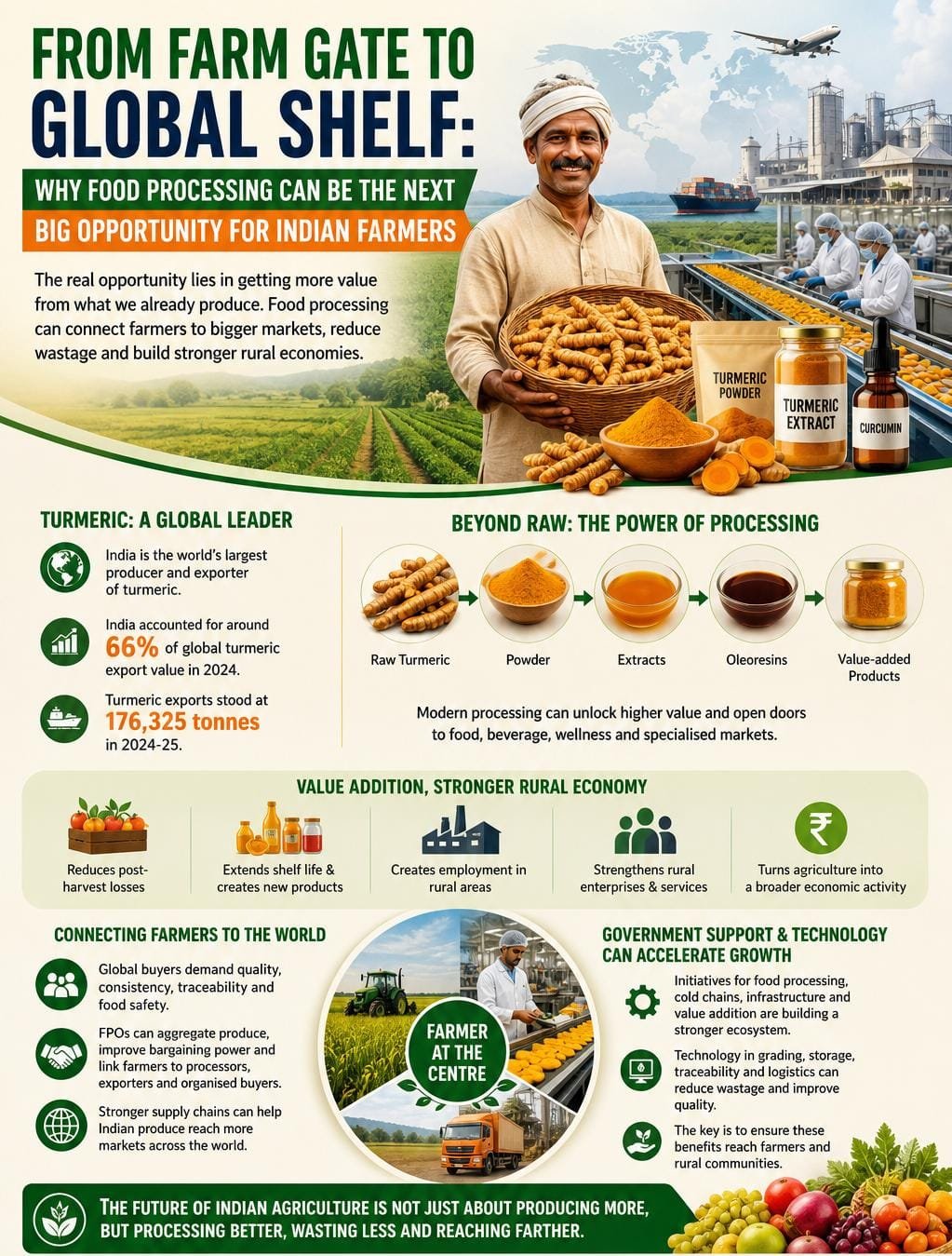
** For Indian agriculture, the next big opportunity may not simply be producing more-it could be about getting more value from what is already being produced.
India has built a strong position in the global agricultural market, from rice and spices to fruits, vegetables and horticultural products. But for millions of farmers, the biggest challenge remains the same: ensuring that the value of their produce does not stop at the farm gate.
This is where food processing can make a meaningful difference.
A larger and more efficient food-processing ecosystem can help farmers find markets for their produce beyond traditional mandis and local buyers. Better storage, grading, packaging, cold-chain facilities and processing units can reduce post-harvest losses while creating opportunities for value addition.
The shift is already underway. Government initiatives aimed at strengthening food processing and agricultural infrastructure are encouraging investment in cold storage, processing facilities, logistics and value chains. The objective is not merely to process food, but to build a system in which farmers, processors, exporters and consumers are better connected.
Turmeric offers a strong example
India’s turmeric story shows the potential of this approach particularly well.
Turmeric has been part of Indian agriculture and household life for generations. From kitchens and traditional practices to international food and wellness markets, Indian turmeric has travelled a long way.
India remains the world’s largest producer and exporter of turmeric. Government data shows that India accounted for around 66% of global turmeric export value in 2024, while turmeric exports stood at 176,325 tonnes in 2024-25.
But the opportunity ahead goes beyond exporting turmeric in its basic form.
With modern processing, turmeric can be converted into powder, extracts, oleoresins and other value-added products. Such products can serve food, beverage and other specialised markets, both within India and overseas.
For farmers, this creates the possibility of participating in a larger value chain rather than depending entirely on the price of raw produce at the time of harvest.
Value addition can strengthen rural economies
The importance of food processing extends well beyond individual crops.
India produces large quantities of mangoes, bananas, tomatoes, grapes, pomegranates, onions and several other agricultural commodities. Yet farmers often face difficulties when there is a glut in the market or when fresh produce cannot be stored for long.
Processing can provide another route.
A mango can become pulp or juice. Tomatoes can be processed into puree and other products. Fruits can be dried, frozen or converted into packaged products. Such possibilities can help extend the shelf life of agricultural produce and create additional demand.
More importantly, processing facilities located closer to farming communities can create employment in rural areas. Packaging, grading, transportation, warehousing, quality testing and logistics all require manpower and services.
This can turn agriculture into a broader rural economic activity.
Connecting Indian farmers with the world
India’s growing agricultural exports also highlight the importance of developing stronger supply chains.
International buyers increasingly look for consistency in quality, packaging, traceability and food safety. Meeting these requirements requires investment not only at the processing stage but across the entire journey from farm to market.
This is where Farmer Producer Organisations (FPOs) can play an important role. By bringing farmers together, FPOs can help aggregate produce, improve bargaining power and establish stronger links with processors, exporters and organised buyers.
For smaller farmers, such collective approaches can make participation in larger domestic and international markets more practical.
Government support can accelerate the transition
The government has been placing greater emphasis on agricultural infrastructure and food processing as part of the broader effort to strengthen farmers’ incomes and rural economies.
Schemes and initiatives supporting food processing, cold chains, agricultural infrastructure and value addition can help create the physical ecosystem required for this transformation.
The opportunity now is to ensure that these investments reach farming communities in a way that produces visible benefits at the ground level.
Technology will also have an important role. Modern grading systems, improved storage, digital supply chains, traceability and efficient logistics can help reduce wastage and improve the quality of products reaching consumers.
The farmer should remain at the centre
The success of India’s food-processing story will ultimately be measured by what it means for the farmer.
If processing companies grow but farmers continue to receive only limited value from their produce, the transformation will remain incomplete. The real opportunity lies in creating stronger connections between farmers and the businesses that process, market and export their produce.
Turmeric provides a particularly encouraging example. A crop that has been cultivated by Indian farmers for generations now has a growing presence in international markets. The next step is to build greater value around it within India—through better processing, branding, quality improvement and global market connections.
The same model can be replicated across India’s diverse agricultural landscape.
India does not need to choose between traditional agriculture and modern food processing. The two can work together. The farmer’s traditional knowledge and experience can be combined with modern technology, infrastructure and international market access.
The future of Indian agriculture may therefore lie not just in producing more, but in processing better, wasting less and reaching farther.
For millions of Indian farmers, the journey from farm gate to global shelf could become one of the most important opportunities for improving incomes and creating a stronger, more resilient rural economy.
By Dr. Nawaz Ahmad Khan, Professor, Acharya Narendra Deva University of Agriculture & Technology , Ayodhya, Uttar Pradesh











Leave a comment