

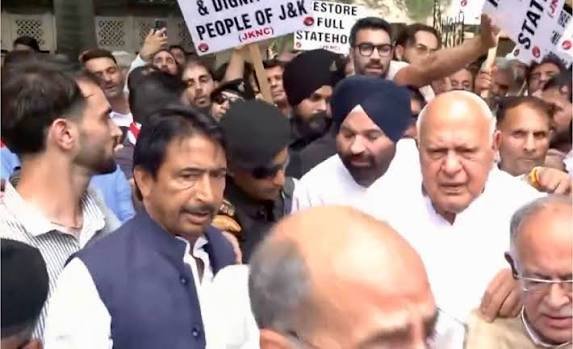
The Jammu and Kashmir statehood debate has returned to the centre of political activity, but the latest protests are also being driven by recruitment and employment concerns. BJP and National Conference moves in Srinagar and Jammu have brought jobs, government vacancies and statehood back into focus.
Why J&K Statehood Is Back at the Centre
The Jammu and Kashmir statehood debate has gained fresh momentum with political parties taking their demands to the streets on September 2, 2026.
The BJP in Jammu and Kashmir has announced a protest march towards the Civil Secretariat in Srinagar, describing recruitment and employment as key concerns. The party’s workers are scheduled to assemble at the Clock Tower in Lal Chowk before marching towards the Secretariat. The protest is being led by J&K BJP president Sat Sharma and Leader of Opposition Sunil Sharma, according to The Indian Express.
The ruling Jammu and Kashmir National Conference has responded by announcing peaceful protests outside BJP offices in Srinagar and Jammu. The party says it wants accountability for commitments made by the Union government in Parliament and before the Supreme Court concerning Jammu and Kashmir.
This has turned the statehood question into more than a constitutional or political issue. For many young people, the debate is closely connected to employment, recruitment opportunities and the functioning of elected institutions.
Recruitment and Employment Become Key Political Issues
Government employment has traditionally carried significant weight in Jammu and Kashmir because public-sector jobs offer relatively stable careers in a region where private-sector opportunities remain uneven.
That makes recruitment delays, vacant posts and the pace of government hiring politically sensitive issues.
The BJP’s latest protest is specifically focused on what it describes as concerns related to recruitment and employment. This is significant because the party is protesting against the government headed by Chief Minister Omar Abdullah, while the National Conference is simultaneously challenging the Centre over its commitments on statehood.
The result is a political contest in which both sides are attempting to frame the same wider issue differently.
For the BJP, employment and recruitment are being used to question the performance of the current J&K administration. For the National Conference, statehood and the Centre’s earlier commitments remain central to its response.
The employment question therefore sits at the intersection of governance, politics and the expectations of young residents.
What Changed After J&K Lost Statehood
Jammu and Kashmir was reorganised into two Union Territories, Jammu and Kashmir and Ladakh, through the Jammu and Kashmir Reorganisation Act, 2019. The change followed the Union government’s decision in August 2019 to abrogate the special constitutional status associated with Article 370.
The Supreme Court upheld the constitutional changes relating to Article 370 in December 2023 and directed that elections to the J&K Legislative Assembly be held by September 30, 2024. The court also said restoration of statehood should happen at the earliest.
Assembly elections were subsequently held in 2024, and the National Conference emerged as the largest party before forming the government with Omar Abdullah as Chief Minister.
That created an unusual political situation. Jammu and Kashmir once again had an elected government and legislature, but the region continued to function as a Union Territory rather than a full-fledged state.
For political parties in J&K, this gap between elected representation and statehood has remained a major issue.
Why Statehood Matters for Governance
The statehood demand is not simply about political symbolism.
Under India’s constitutional structure, a state has a different institutional position from a Union Territory. The distribution of powers, administrative arrangements and relationship with the Union government differ depending on the constitutional status of the territory.
In Jammu and Kashmir, the question is particularly complicated because the Union Territory has an elected legislative assembly, but key areas of administration remain connected to the Lieutenant Governor’s office under the existing legal framework.
This has produced continuing political arguments over who should exercise authority and how much decision-making power an elected government should have.
The National Conference has made restoration of statehood a prominent political demand. The party’s latest response to the BJP protest again refers to commitments made by the Centre in Parliament and before the Supreme Court.
The BJP, meanwhile, has challenged Omar Abdullah to seek a fresh mandate specifically on the statehood question, according to The Indian Express.
Young People Are Watching the Employment Question
The recruitment debate has a particularly strong connection with younger residents.
A large number of educated young people in Jammu and Kashmir prepare for competitive examinations for government posts. Recruitment to administrative services, police, education, health and other departments can therefore affect thousands of applicants.
When recruitment schedules are delayed or posts remain unfilled, the impact extends beyond individual candidates. It can affect career planning, household finances and decisions about whether to remain in the region or look for opportunities elsewhere.
The issue is also visible in recent protests by medical interns.
MBBS and BDS interns across medical colleges in Jammu and Kashmir began an indefinite strike over their monthly stipend, demanding an increase from Rs 12,300 to Rs 30,000. The protesting interns said the stipend had remained unchanged for years despite rising living costs and the demanding nature of their duties.
Although the internship dispute is separate from the statehood protests, it illustrates the broader employment and remuneration pressures facing young professionals in the region.
Medical Intern Protest Adds to Youth Employment Concerns
The medical interns’ agitation has added another layer to the discussion around opportunities and working conditions for young professionals in J&K.
According to reports, the interns cited long working hours, emergency duties, night shifts and rural postings while seeking a higher stipend. They also pointed to higher stipend levels available in several other states.
The health sector dispute should not be treated as direct evidence of the causes behind the current political protests. However, it shows why employment-related questions can quickly become politically significant.
For graduates and young professionals, the issue is not only whether a job exists. Salary, recruitment timelines, career progression and working conditions also influence whether opportunities in the region are considered viable.
That makes employment a practical issue that can sit alongside the much larger political question of statehood.
BJP and National Conference Take Different Positions
The latest developments have created a direct political confrontation between the BJP and National Conference.
The BJP’s planned Secretariat gherao is aimed at the Omar Abdullah government and focuses on recruitment and employment concerns. The National Conference has announced a counter-protest at BJP offices, saying the Centre should be held accountable for its commitments on J&K.
The competing protests show how statehood has become part of a broader political argument about governance.
National Conference leaders have argued that the party’s electoral mandate does not amount to a blank cheque and that the Centre must answer for commitments connected to Jammu and Kashmir.
The BJP, on the other hand, has questioned the J&K government’s performance and challenged the Chief Minister over the statehood issue.
This political positioning is likely to keep recruitment, employment and administrative powers in public discussion.
The Larger Question Is Jobs Plus Political Representation
The latest protests should not be viewed only through the lens of statehood.
For ordinary residents, especially young job seekers, political status matters partly because it is connected to how governance works. Recruitment policies, administrative decisions and the functioning of government departments directly affect everyday life.
At the same time, the statehood debate has a constitutional and political dimension that cannot be reduced to employment.
The two issues are therefore overlapping rather than identical.
Jammu and Kashmir’s political parties are now competing to define what the public should consider the most urgent issue: employment and recruitment under the present administration, or restoration of full statehood and greater political autonomy within the Indian constitutional framework.
The street protests in Srinagar and Jammu show that both questions remain politically active.
What Happens Next in Jammu and Kashmir
The immediate focus will be on the planned protests, the response from the J&K government and the continuing political debate between the National Conference and BJP.
The employment question could remain particularly important because it has a direct impact on young residents and aspiring government employees.
At the same time, the National Conference is expected to continue pressing the Centre on statehood, especially after the 2024 Assembly elections restored an elected government in the Union Territory.
The latest developments do not by themselves establish any new policy decision on statehood or recruitment. They show that both issues have become central points of political mobilisation.
For Jammu and Kashmir, the debate now extends beyond the question of what constitutional status the region should have. It is also about whether young residents see sufficient opportunities to build careers and futures within the region.
Key Takeaways
- The BJP’s J&K unit has announced a Secretariat protest in Srinagar focused on recruitment and employment concerns.
- The National Conference has announced counter-protests outside BJP offices in Jammu and Srinagar and is demanding accountability from the Centre over its commitments concerning J&K.
- The statehood issue remains unresolved even after Jammu and Kashmir returned to an elected government following the 2024 Assembly elections.
- Recent protests by MBBS and BDS interns over low stipends also highlight wider concerns among young professionals about employment conditions in J&K.
Frequently Asked Questions
Why are protests taking place in Jammu and Kashmir now?
The latest protests are linked to competing political demands. The BJP has announced a protest against the J&K government focusing on recruitment and employment, while the National Conference has announced counter-protests demanding accountability from the Centre over commitments related to Jammu and Kashmir.
Why is statehood important for Jammu and Kashmir?
Statehood would change the constitutional and administrative position of Jammu and Kashmir compared with its current status as a Union Territory. The restoration of statehood has remained a major political demand since the region’s reorganisation in 2019.
How is employment connected to the statehood debate?
Employment is not the same issue as statehood, but both are linked to questions of governance and administrative decision-making. Recruitment delays, vacancies and working conditions directly affect young people, making employment a politically important issue.
What is the current status of Jammu and Kashmir?
Jammu and Kashmir is currently a Union Territory with an elected legislative assembly. Assembly elections were held in 2024, after which the National Conference-led government under Omar Abdullah took office. The restoration of statehood remains a major political demand.
(Jammu Kashmir statehood, J&K statehood debate, Jammu Kashmir protests, J&K recruitment news, Jammu Kashmir government jobs, Omar Abdullah, National Conference BJP J&K, Srinagar protest, Jammu employment news, Jammu Kashmir youth jobs, J&K government recruitment, Jammu Kashmir latest news)






Leave a comment