

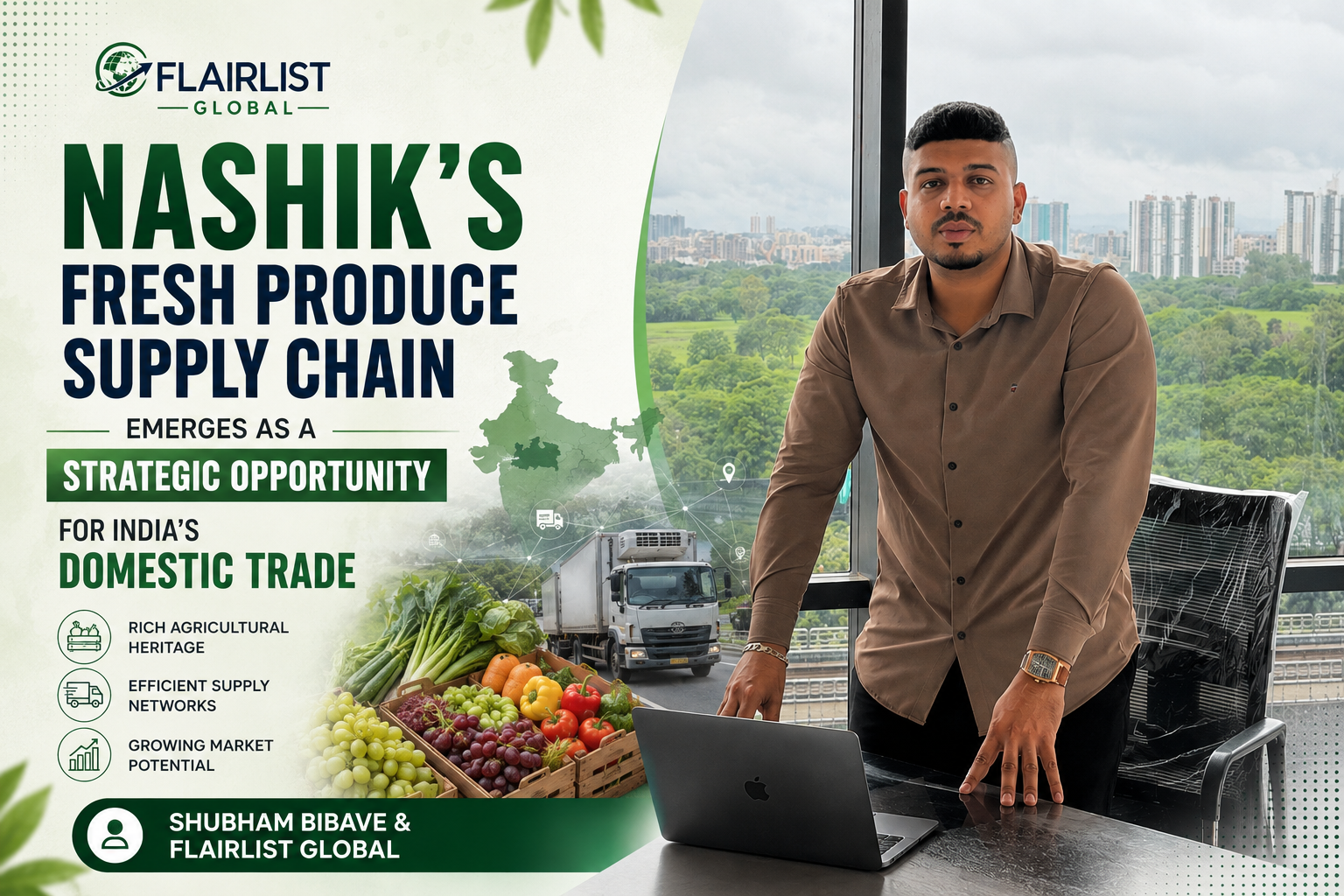
Nashik is once again drawing attention in India’s agricultural trade landscape as changing onion arrivals, price movements and new transportation initiatives highlight the importance of connecting regional supply with major consumption markets.
The development comes at a time when India’s fresh-produce supply chains are facing a familiar challenge: production is concentrated in specific regions, while demand is distributed across cities and markets nationwide.
Recent developments in Nashik’s onion trade provide a clear illustration of this gap.
On August 26, 2026, a special goods train carrying approximately 450–500 metric tonnes of onions departed from Lasalgaon in Nashik for Delhi, creating an alternative channel to move substantial volumes from one of India’s major onion-producing and trading centres to a major consumption market.
While the immediate objective is to strengthen onion supplies in Delhi, the development also highlights a broader opportunity for Indian agricultural businesses: building more efficient connections between producing regions and markets with consistent demand.
For Shubham Bibave and FlairList Global, the significance extends beyond the current onion market. Nashik’s broader fresh-produce ecosystem demonstrates how regional supply can become a foundation for domestic market expansion when supported by better market intelligence, buyer connections and supply-chain execution.
Why Nashik Remains Important to India’s Agricultural Trade
Nashik has developed into one of Maharashtra’s most important agricultural and horticultural centres, supported by established farming communities, wholesale markets, traders, processors and logistics networks.
Lasalgaon, in particular, has long been associated with India’s onion trade.
Recent market movements demonstrate the scale and sensitivity of this ecosystem. Average wholesale onion prices at Lasalgaon increased from around ₹2,180 per quintal on August 8 to approximately ₹2,760 per quintal by August 14. During the same period, daily arrivals reportedly declined from around 15,000 quintals to nearly 8,000 quintals.
Such movements are significant because they demonstrate how quickly agricultural markets can respond to changes in supply.
For businesses operating within the fresh-produce sector, this creates a need to monitor more than market prices.
Arrivals, production cycles, weather conditions, transportation availability, quality and buyer demand all influence the final commercial outcome.
The Fresh Produce Opportunity Extends Beyond Onions
Although onions are currently driving much of the attention around Nashik, the region’s agricultural economy is considerably broader.
Nashik markets handle a diverse range of fruits and vegetables, creating potential sourcing opportunities for distributors, institutional buyers, retailers, processors and traders across India.
This diversity matters because domestic agricultural trade is gradually becoming more structured.
A buyer in another state may require a particular quantity of vegetables every week. A food processor may require a defined grade of raw material. A distributor may be looking for reliable seasonal supply.
In each case, the commercial requirement is not simply “product available.”
It is:
Product + Quantity + Quality + Packing + Location + Price + Logistics + Delivery Schedule
The ability to coordinate these factors determines whether a supply opportunity can become a sustainable trade relationship.
Logistics Is Becoming Part of the Commercial Equation
The movement of onions from Lasalgaon to Delhi also underlines the growing importance of logistics in agricultural trade.
Fresh produce is highly sensitive to time and transportation costs. Unlike many manufactured goods, agricultural commodities can experience quality deterioration and price changes while in transit.
This makes the choice of transportation and route an important commercial consideration.
The special rail movement from Nashik to Delhi demonstrates how alternative logistics channels can be used when large quantities need to be moved between production and consumption centres.
For suppliers and buyers, the lesson is broader.
A competitive product without an efficient delivery mechanism may not remain commercially competitive.
As a result, domestic trade decisions increasingly need to consider the complete landed cost rather than the procurement price alone.
Supply Visibility Could Become a Competitive Advantage
One of the biggest challenges in agricultural trade is visibility.
Suppliers may have significant quantities available without direct access to buyers outside their traditional markets.
At the same time, buyers may have genuine requirements but limited visibility into where suitable supply is available.
This disconnect creates inefficiencies.
A supplier in Nashik may be able to fulfil a large requirement, while a buyer several hundred kilometres away may still struggle to identify that supply.
Improving this visibility can therefore create value on both sides.
For Shubham Bibave and FlairList Global, this is an important part of the broader domestic-trade opportunity.
The objective is not simply to identify products.
It is to create clearer connections between available supply and identifiable demand, while allowing businesses to evaluate the commercial details required for execution.
Weather Adds Another Layer of Uncertainty
Agricultural supply chains are also increasingly influenced by weather and seasonal timing.
In Nashik, delayed monsoon conditions have affected kharif onion transplantation. Reports in August indicated that transplantation had covered only around 500 hectares compared with the district’s usual 30,000-hectare cultivation area at that stage.
The significance goes beyond the current season.
Changes in planting schedules can influence future harvest periods, market arrivals and price behaviour.
For buyers and traders, this reinforces the importance of forward-looking market intelligence.
Understanding what is happening today is useful.
Understanding how today’s agricultural conditions could influence tomorrow’s availability can be even more valuable.
What This Means for Domestic Buyers
For buyers sourcing fresh produce from Nashik, several factors should be considered before entering into a large-volume transaction.
First is quality consistency.
A single sample may not represent the quality of an entire commercial lot.
Second is quantity reliability.
Available stock should be assessed against the actual delivery requirement rather than assumed from a general market indication.
Third is logistics.
Transportation costs, loading schedules and delivery timelines can materially affect the final economics.
Finally, buyers should establish clear commercial terms covering specifications, payment, packing and delivery responsibilities.
This becomes particularly important when sourcing from a new supplier or entering a new regional market.
What This Means for Nashik Suppliers
The opportunity is equally significant for suppliers.
Nashik-based farmers, aggregators, traders and businesses with dependable fresh-produce supply can potentially access markets beyond their immediate trading network.
However, market expansion requires professional presentation of supply.
A buyer needs to know:
* What product is available?
* What quantity can be supplied?
* What quality or grade is offered?
* What packing is available?
* Where is the material located?
* What is the workable rate?
* How quickly can it be dispatched?
* Can the supply be repeated?
Clear answers to these questions can significantly reduce the friction involved in initiating a trade relationship.
From Local Supply to Wider Market Access
The larger opportunity for Nashik is therefore not limited to selling more onions.
It is about creating stronger connections between the region’s agricultural production and demand across India.
The same infrastructure and market relationships that support onion trade can potentially support other fresh commodities.
This creates an important pathway for domestic trade:
Regional Production → Aggregation → Quality Control → Market Access → Logistics → End Buyer
When each stage is coordinated effectively, regional supply can become more accessible to a much larger buyer base.
For India, this has implications beyond individual transactions.
More efficient domestic supply chains can improve sourcing flexibility, create additional market opportunities for producers and help businesses respond more effectively to changing demand.
The Bigger Opportunity for Indian Agricultural Businesses
Nashik’s current market activity offers a useful case study in how India’s domestic trade ecosystem is evolving.
The country already has substantial agricultural production capacity.
The challenge is increasingly about connecting that capacity with demand in a timely, transparent and commercially viable manner.
The recent movement of hundreds of tonnes of onions from Lasalgaon to Delhi is one example of how infrastructure can help bridge the distance between production and consumption.
But infrastructure is only one part of the equation.
Market intelligence, buyer discovery, product specifications, pricing, quality assurance and execution are equally important.
For businesses looking beyond traditional local markets, the opportunity lies in combining these elements into a reliable trade process.
For Shubham Bibave and FlairList Global, this represents a broader vision for domestic and international commerce: helping businesses move from simply having supply to identifying the right market, the right buyer and the right execution pathway.
As Nashik’s agricultural ecosystem continues to evolve, its importance may increasingly be measured not only by what it produces, but by how effectively that production can reach markets across India and beyond.
About Shubham Bibave
Shubham Bibave is the Founder and CEO of FlairList Global, an India-based business execution ecosystem focused on trade, market access, supply chains and business expansion.
His work focuses on creating structured approaches that help businesses identify opportunities, develop market connections and participate more effectively in domestic and international trade.
About FlairList Global
FlairList Global is a global business execution ecosystem working across domestic and international trade, supply chains, market access and business expansion.
The platform works with exporters, importers, manufacturers, traders, suppliers and businesses seeking to develop new market opportunities and build stronger commercial connections.
Explore FlairList Global: www.flairlist.com
For businesses with fresh agricultural supply from Nashik, the opportunity is increasingly clear: the next stage of growth may not simply come from producing more, but from connecting existing supply with the right markets through better visibility, stronger buyer relationships and reliable execution.











Leave a comment