

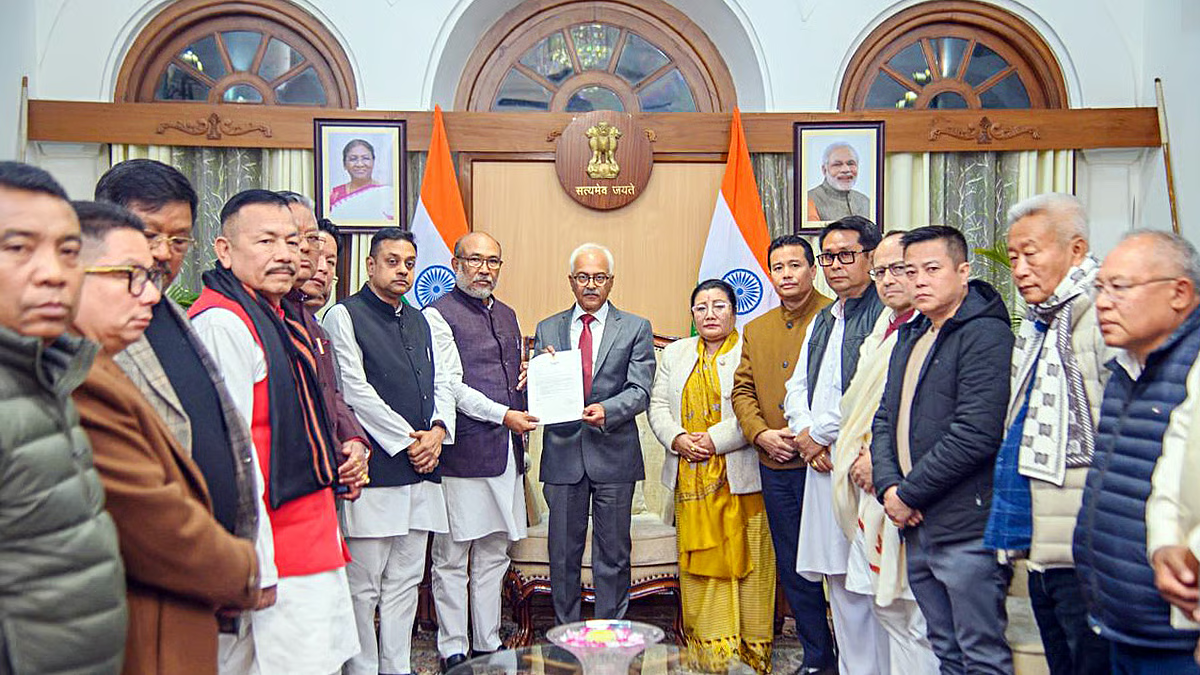
After nearly 18 months of political uncertainty, Manipur has a new government in place, ending a prolonged administrative vacuum. The transition comes at a sensitive moment, with expectations around political stability, governance reform, and long delayed policy action now firmly in focus across the state.
Background of the 18-Month Political Void
Manipur’s political vacuum followed a breakdown in coalition alignment and leadership paralysis that left the state without effective executive direction. While the constitutional machinery continued to function, decision making slowed significantly. Major policy announcements were deferred, development approvals stalled, and coordination between departments weakened.
For residents, the absence of clear political leadership translated into uncertainty. Infrastructure projects faced repeated delays, recruitment processes remained frozen, and conflict management suffered from inconsistent administrative messaging. The prolonged gap also strained relations between the state administration and the Centre, particularly on security coordination and rehabilitation efforts.
The formation of a new government brings closure to this phase, but it also raises immediate questions about whether stability will hold or remain fragile.
Composition and Political Signals from the New Government
The new government’s composition reflects a calculated attempt to balance regional representation, coalition interests, and administrative continuity. Key portfolios have been assigned to experienced legislators rather than first time ministers, signaling an emphasis on control and predictability rather than experimentation.
This cabinet structure suggests that political stability is the immediate priority. The leadership has avoided disruptive reshuffles and instead focused on restoring bureaucratic momentum. Early statements from the government have emphasized governance, peace, and delivery over ideology.
For Manipur, where political volatility has historically impacted development outcomes, this approach is designed to reassure both civil servants and the public that day to day administration will not be derailed by internal power struggles.
Policy Priorities Likely to Take Center Stage
Several policy areas are expected to dominate the new government’s agenda. Law and order remains the most urgent. The prolonged instability weakened enforcement capacity and public confidence. Restoring administrative authority at the district level will be critical.
Economic recovery is another focus. Small traders, transport operators, and local businesses have faced prolonged uncertainty. The government is expected to fast track pending infrastructure projects, clear delayed payments, and restart employment linked schemes that were paused during the political impasse.
Social welfare delivery is also under scrutiny. Delays in benefit disbursal and implementation gaps widened during the leadership vacuum. Addressing these quickly will be essential to rebuild trust, especially in rural and conflict affected areas.
Challenges to Sustaining Political Stability
Despite the formation of a new government, stability is not guaranteed. Coalition dynamics remain sensitive, and internal disagreements could resurface if governance outcomes do not improve quickly. Managing expectations within the ruling alliance will require constant negotiation.
Public patience is another factor. After 18 months of uncertainty, there is limited tolerance for delays or symbolic gestures. Citizens are looking for visible action, particularly on security, livelihoods, and public services.
Additionally, coordination with the central government will shape outcomes. Effective alignment can accelerate funding and policy execution, while friction could slow progress. The new leadership’s ability to maintain constructive engagement will directly influence its success.
What Comes Next for Governance in Manipur
The next six months will be decisive. Administrative momentum needs to be restored rapidly to signal that the political vacuum is truly over. Early governance wins, even small ones, will matter more than long term promises.
If the government can stabilize the coalition, rebuild bureaucratic confidence, and deliver on core policy priorities, it has an opportunity to reset Manipur’s political narrative. Failure to do so risks returning the state to uncertainty, with higher political and social costs.
For now, the formation of a new government marks a necessary first step. Whether it becomes a turning point depends on execution, cohesion, and sustained political discipline.
Takeaways
Manipur’s new government ends an 18-month phase of political uncertainty
Stability and administrative continuity are the immediate priorities
Law and order, economic recovery, and welfare delivery top the policy agenda
The next six months will determine whether stability is durable or temporary
FAQs
Why did Manipur experience an 18-month political vacuum
Coalition breakdowns and leadership disputes prevented the formation of a stable government, slowing decision making and governance.
Does the new government guarantee long term stability
No, stability depends on coalition cohesion, governance delivery, and public confidence over time.
What policy areas need urgent attention
Law and order, stalled infrastructure projects, economic recovery, and welfare scheme implementation.
How soon can citizens expect visible change
Initial administrative actions are expected within months, but sustained impact will depend on consistent execution.










Leave a comment