

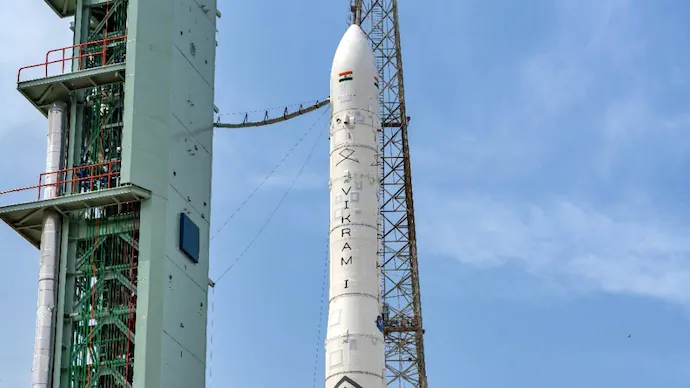
Skyroot Aerospace’s Vikram-1 mission marks a defining moment for India’s private space industry. As the country’s first privately developed orbital rocket prepares for its maiden launch, the mission reflects how government reforms, private innovation, and growing commercial demand are reshaping India’s role in the global space economy.
The topic is time-sensitive news, as Vikram-1 is scheduled for its maiden launch on July 18, 2026. Therefore, this article follows a news reporting style while also explaining the broader significance of the mission.
India’s private space ambitions are entering a new phase with Skyroot Aerospace’s Vikram-1 launch, a mission widely regarded as a milestone for the country’s commercial space sector. If successful, Vikram-1 will become the first privately developed Indian orbital rocket to launch from Indian soil, demonstrating that private companies can build and operate launch vehicles alongside the Indian Space Research Organisation (ISRO). The mission represents years of policy reforms, technological innovation, and growing investment in India’s space ecosystem.
Vikram-1 Is More Than Just Another Rocket
Named after Dr. Vikram Sarabhai, the father of India’s space programme, Vikram-1 is designed by Hyderabad-based Skyroot Aerospace. The mission, called Mission Aagaman, is primarily a demonstration flight intended to validate the rocket’s design, propulsion systems, avionics, and flight performance before commercial operations begin.
Unlike ISRO’s government-developed launch vehicles, Vikram-1 has been designed, manufactured, and integrated by a private Indian company. That makes this launch historically significant. It signals that India’s private sector is becoming capable of developing advanced launch technologies that were once limited to national space agencies.
The rocket is intended to place small satellites into low Earth orbit, a rapidly growing segment of the global satellite launch market driven by communication, Earth observation, and scientific missions.
How India’s Space Reforms Made This Possible
India’s private space industry has expanded rapidly since the government opened the sector to private participation through regulatory reforms beginning in 2020. The establishment of IN-SPACe created a framework that allows private companies to access ISRO facilities, testing infrastructure, and launch sites while developing their own technologies.
These reforms encouraged startups such as Skyroot Aerospace, Agnikul Cosmos, Pixxel, Digantara, Bellatrix Aerospace, and several others to enter the space technology ecosystem.
Instead of competing with ISRO, these companies complement the national programme by focusing on commercial launches, satellite manufacturing, propulsion systems, and space services. Vikram-1 is among the strongest examples of how these reforms are translating into real launch capabilities.
Why the Mission Matters for India’s Commercial Space Economy
The global demand for launching small satellites has increased significantly over the past decade. Governments, universities, research organisations, and private businesses increasingly rely on smaller satellites for communication, weather monitoring, agriculture, mapping, and defence applications.
A successful Vikram-1 mission would strengthen India’s position in this growing market by offering another domestic launch option.
Commercial launch capability also creates opportunities beyond rocket manufacturing. It encourages investment in component suppliers, software developers, electronics manufacturers, precision engineering firms, and research institutions across the country.
For many Tier-2 cities with strong engineering talent, this growing space economy could create new employment opportunities without requiring companies to be based only in major metropolitan areas.
Technology Behind Vikram-1
Vikram-1 is a four-stage launch vehicle featuring three solid-fuel stages and a restartable liquid-fuel upper stage. The restart capability allows greater flexibility in placing satellites into their intended orbits.
The mission also builds upon Skyroot’s earlier achievement with the Vikram-S suborbital launch in 2022, which successfully demonstrated several technologies now incorporated into Vikram-1.
According to the company, many critical systems have already undergone extensive testing before this first orbital attempt. However, as with any maiden rocket launch, engineers expect the mission to provide valuable technical data regardless of the final outcome.
What Success Could Mean for Future Indian Space Startups
If Vikram-1 completes its mission successfully, investor confidence in India’s private space sector is likely to strengthen further.
Space technology has traditionally required significant capital because of long development timelines and complex engineering challenges. Demonstrating a successful orbital launch would show that Indian startups can execute projects at global standards.
This could encourage additional venture capital investment, international partnerships, satellite launch contracts, and deeper collaboration between academia, industry, and government agencies.
It would also reinforce India’s ambition of expanding its share in the rapidly growing global space economy over the coming decade.
Challenges Still Remain
While Vikram-1 represents a major step forward, India’s private space sector still faces several challenges.
Building launch vehicles is only one part of the commercial ecosystem. Companies also need consistent launch schedules, access to international customers, regulatory clarity, insurance support, manufacturing capacity, and long-term funding.
Global competition is also intense, with companies in the United States, Europe, and China already serving commercial satellite markets.
For India to become a major launch destination, private firms will need to demonstrate reliability across multiple successful missions rather than a single launch.
Looking Ahead
The Vikram-1 launch represents more than the debut of a new rocket. It reflects India’s transition from a government-led space programme to a broader ecosystem where private companies contribute to innovation, manufacturing, and commercial services.
Whether viewed from the perspective of technology, business, or national capability, the mission has the potential to reshape India’s position in the global space industry. As the countdown begins, Vikram-1 stands as one of the most closely watched milestones in India’s modern space journey.
Key Takeaways
- Vikram-1 is India’s first privately developed orbital-class rocket scheduled for its maiden launch.
- The mission showcases the impact of India’s space sector reforms and growing private participation.
- A successful launch could boost commercial satellite services, investment, and employment opportunities.
- The mission positions India to compete more strongly in the global small satellite launch market.
FAQ
Q1. What is Vikram-1?
Vikram-1 is a privately developed orbital launch vehicle built by Skyroot Aerospace for launching small satellites into low Earth orbit.
Q2. Why is Vikram-1 important for India?
It represents India’s first attempt to launch a privately developed orbital rocket from Indian soil, marking a major milestone for the country’s commercial space sector.
Q3. Who developed Vikram-1?
The rocket has been developed by Hyderabad-based Skyroot Aerospace, a private space technology startup founded by former ISRO engineers.
Q4. How could this launch benefit India?
A successful mission could attract investment, expand commercial launch services, create high-skilled jobs, and strengthen India’s position in the global space economy.












Leave a comment