

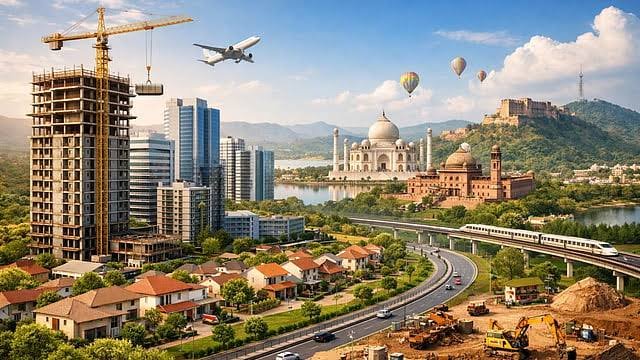
India’s rapidly expanding space sector is no longer limited to Bengaluru or Hyderabad. Tier-2 cities are emerging as important hubs for manufacturing, research, engineering, and innovation, positioning themselves to benefit from the country’s growing commercial space economy and increasing private sector participation.
The topic is evergreen with a strong current affairs angle. It is based on ongoing developments in India’s expanding commercial space industry rather than a single breaking news event. Therefore, this article follows an explanatory and analytical style while incorporating recent developments in the Indian space sector.
India’s space economy is entering a period of rapid transformation, and Tier-2 cities are preparing for India’s next space economy boom by investing in infrastructure, manufacturing, skilled talent, and technology-driven industries. The opening of India’s space sector to private companies, combined with rising demand for satellite services and commercial launches, has created opportunities that extend well beyond traditional aerospace hubs. Cities such as Nagpur, Coimbatore, Indore, Ahmedabad, Bhubaneswar, Mysuru, Lucknow, and Visakhapatnam are steadily positioning themselves as contributors to the country’s growing space ecosystem.
Experts believe the next phase of India’s space industry will depend not only on rocket launches but also on thousands of suppliers, component manufacturers, software developers, research institutions, and engineering firms spread across multiple cities. This decentralised growth could significantly strengthen regional economies while creating new employment opportunities.
India’s Space Sector Is Expanding Beyond Traditional Hubs
For decades, India’s space programme revolved around organisations like the Indian Space Research Organisation (ISRO) and major centres located in Bengaluru, Sriharikota, Thiruvananthapuram, and Hyderabad. However, the landscape has changed considerably since the Government of India introduced reforms that encouraged private participation in the space sector.
The establishment of the Indian National Space Promotion and Authorization Center (IN-SPACe) and policy support for private companies have encouraged startups to build launch vehicles, satellites, propulsion systems, communication technologies, and Earth observation platforms.
This shift has created demand for suppliers across the country. Instead of concentrating every activity in one city, companies are building extensive supply chains that involve manufacturers, electronics firms, precision engineering businesses, and research institutions located in Tier-2 cities.
Manufacturing Is Becoming a Major Growth Driver
One of the biggest opportunities for Tier-2 cities lies in advanced manufacturing.
Space missions require thousands of precision-engineered components, including valves, sensors, lightweight structures, composite materials, electronics, batteries, propulsion hardware, and testing equipment. Many small and medium enterprises already serving the automotive, defence, and industrial sectors are adapting their expertise to meet aerospace standards.
Cities such as Coimbatore, Rajkot, Pune, Aurangabad, and Nagpur have well-established manufacturing ecosystems capable of supporting high-quality production. As private space companies scale operations, these industrial clusters are expected to play a larger role in supplying critical components.
This diversification also helps reduce dependence on imports while strengthening India’s domestic manufacturing capabilities.
Engineering Talent Is No Longer Limited to Metro Cities
India produces a large number of engineering graduates every year, many of whom study in universities located outside metropolitan regions.
Tier-2 cities now host engineering colleges, technical universities, incubation centres, and startup ecosystems that support innovation in robotics, electronics, artificial intelligence, embedded systems, and aerospace technologies.
Young professionals increasingly prefer working closer to their hometowns if attractive career opportunities are available. This trend has encouraged companies to establish design centres, research facilities, and manufacturing units outside major metros where operational costs are comparatively lower.
As India’s commercial space industry expands, demand is expected to grow for software engineers, aerospace specialists, data analysts, satellite communication experts, and advanced manufacturing professionals.
Space Startups Are Creating New Regional Opportunities
India’s private space ecosystem has grown rapidly over the past few years. Companies such as Skyroot Aerospace, Agnikul Cosmos, Pixxel, Digantara, Bellatrix Aerospace, and Dhruva Space have demonstrated that innovative space technology can be developed by private enterprises.
While many of these startups are headquartered in major cities, their operations increasingly depend on nationwide supplier networks, specialised vendors, academic collaborations, and testing partners.
Tier-2 cities stand to benefit by becoming satellite manufacturing centres, electronics production hubs, logistics partners, software development locations, and testing facilities.
Local startups are also entering related sectors such as drone technology, geospatial analytics, satellite data processing, remote sensing applications, and artificial intelligence solutions that complement India’s broader space economy.
Infrastructure and Government Support Are Accelerating Growth
Several state governments have launched initiatives to attract investments in aerospace and advanced manufacturing.
Industrial corridors, defence manufacturing clusters, innovation parks, startup incubators, and electronics manufacturing zones are creating an ecosystem that supports space-related industries.
Government programmes promoting semiconductor manufacturing, electronics production, digital infrastructure, and research collaborations further strengthen these efforts.
The availability of improved highways, airports, freight connectivity, and digital infrastructure makes Tier-2 cities increasingly attractive for companies seeking cost-effective expansion without compromising operational efficiency.
This balanced regional development could reduce pressure on major metropolitan centres while spreading economic growth across multiple states.
Challenges That Need Attention
Despite growing opportunities, several challenges remain before Tier-2 cities can become major contributors to India’s space economy.
Advanced aerospace manufacturing requires highly specialised skills, strict quality standards, sophisticated testing facilities, and significant capital investment. Many smaller cities still need additional research infrastructure, skilled workforce development, and stronger industry-academia collaboration.
Access to venture capital also remains uneven outside established startup ecosystems. Encouraging greater private investment, expanding technical training programmes, and improving collaboration between universities and industry will be essential for long-term success.
Addressing these gaps early can help ensure that regional cities participate meaningfully in India’s expanding commercial space sector.
The Road Ahead
India’s ambitions in space extend far beyond launching rockets. The future space economy will include satellite communications, climate monitoring, navigation services, defence applications, precision agriculture, disaster management, manufacturing, artificial intelligence, and commercial space services.
Tier-2 cities are well positioned to become an important part of this transformation because they already possess strong engineering talent, growing industrial capacity, competitive operating costs, and expanding digital infrastructure.
As public and private investments continue to increase, these cities could emerge as key contributors to India’s goal of becoming one of the world’s leading space economies. Rather than remaining spectators, Tier-2 cities are steadily preparing to become active participants in the country’s next phase of technological and industrial growth.
Key Takeaways
- India’s private space sector is creating new opportunities beyond traditional aerospace hubs.
- Tier-2 cities are emerging as centres for manufacturing, engineering, research, and innovation.
- Strong industrial ecosystems and skilled talent make regional cities attractive for space-related investments.
- Continued infrastructure development and workforce training will determine long-term growth.
FAQ
Q1. Why are Tier-2 cities important for India’s space economy?
Tier-2 cities offer skilled engineering talent, manufacturing capabilities, lower operating costs, and growing industrial infrastructure that support space technology companies.
Q2. Which industries in Tier-2 cities can benefit from the space sector?
Precision manufacturing, electronics, software development, artificial intelligence, satellite data services, logistics, and advanced engineering are among the sectors expected to benefit.
Q3. What role do private space companies play in this growth?
Private companies are expanding satellite manufacturing, launch services, propulsion technologies, and commercial space applications while creating nationwide supplier networks.
Q4. Can India’s regional cities become global aerospace hubs?
With continued investment in infrastructure, research, skilled workforce development, and policy support, many Tier-2 cities have the potential to become significant contributors to the global aerospace supply chain.









Leave a comment