

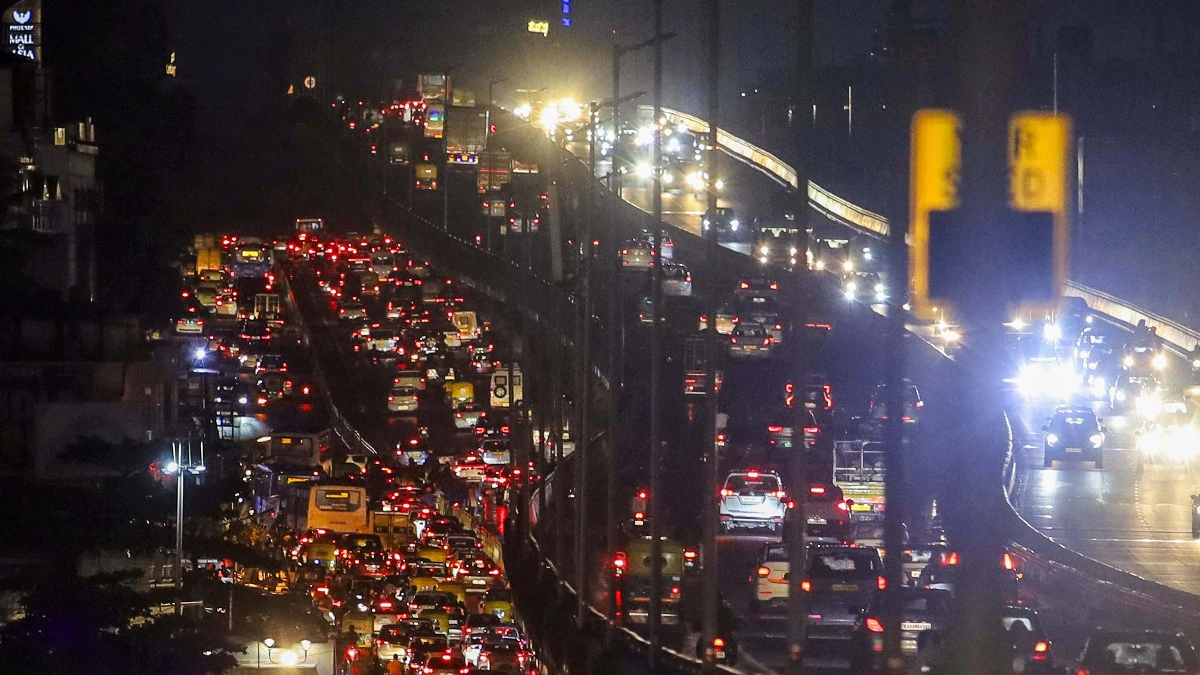
Indian cities are facing slower rush-hour journeys as rising vehicle volumes, road bottlenecks, construction, weather disruptions and uneven public transport put pressure on urban roads. Recent traffic data shows that congestion is not limited to metros, with several Indian cities recording significant time lost during peak travel hours.
Indian cities are becoming slower during peak hours
Indian cities are losing commuting speed during rush hour as more vehicles compete for limited road space and urban transport systems struggle to keep pace with rapidly expanding populations and economic activity.
The latest TomTom Traffic Index data shows the scale of the problem. Bengaluru recorded a congestion level of 74.4%, followed by Pune at 71.1%, Mumbai at 63.2% and New Delhi at 60.2%. Bengaluru drivers lost an estimated 168 hours to rush-hour congestion, while Pune commuters lost 152 hours.
The issue is no longer simply about traffic jams. Slower average speeds affect how people reach workplaces, schools, hospitals, railway stations and commercial areas. For residents of growing Tier-2 cities, the same pattern is increasingly visible as vehicle ownership and construction activity expand.
Traffic congestion is reducing average travel speeds
Traffic congestion does not necessarily mean vehicles remain completely stationary. A city can experience serious congestion even when traffic continues moving slowly.
TomTom’s India data puts the country’s average speed at around 21.9 km/h under its overall traffic measurement, compared with 20.8 km/h during the selected rush-hour measurement shown in its country overview. The average distance covered in 15 minutes also falls from 5.5 km under the broader measure to 5.2 km during rush-hour conditions.
That difference becomes significant over a daily commute.
For example, a journey that normally takes 25 minutes can stretch considerably when several intersections become overloaded. A small delay at one junction can also spread backward through connected roads, creating a longer queue several kilometres away.
This is why commuters often experience traffic as unpredictable rather than simply slow.
More vehicles are competing for the same road space
One of the simplest reasons for declining commuting speeds is the growing number of vehicles using urban roads.
Indian cities have experienced rapid growth in private vehicle ownership, including cars, motorcycles and scooters. At the same time, road space cannot expand at the same rate as vehicle numbers.
Nagpur provides a useful Tier-2 city example. Recent reporting has put the city’s registered vehicle count at more than 33 lakh, while key corridors face congestion linked to vehicle growth, infrastructure work, parking problems and traffic violations.
This creates a difficult equation. Building a wider road may temporarily increase capacity, but if more vehicles quickly begin using that road, the benefit can diminish.
Urban transport therefore depends on more than adding lanes. It also requires efficient public transportation, better traffic management, parking regulation and coordinated land-use planning.
Road construction can make existing congestion worse
Infrastructure projects are intended to improve mobility in the long term, but they can create serious short-term disruption.
Flyovers, metro construction, drainage work, road resurfacing, sewage projects and utility work often require lane closures or traffic diversions. When a major road becomes narrower, traffic is pushed onto surrounding streets that may already operate close to capacity.
This is particularly visible during periods when multiple infrastructure projects happen simultaneously.
In Nagpur, for example, ongoing road and infrastructure work has been reported as one of several factors contributing to congestion on important corridors. Traffic diversions and narrower stretches can make existing bottlenecks worse.
The same principle applies to larger metropolitan areas. A construction project does not need to block an entire road to affect commuting speeds. Reducing road capacity at a critical junction can be enough to create queues during peak hours.
Monsoon weather adds another layer of disruption
Weather is another important factor behind slower urban travel.
Heavy rain can reduce visibility, force drivers to reduce speed and create waterlogging on roads. Flooded stretches can also force vehicles to take alternative routes, shifting traffic onto roads that were not designed to handle the additional volume.
Recent traffic conditions in Indian cities have demonstrated how quickly weather and other temporary events can combine with existing congestion. In Delhi, for instance, recent rain added to traffic disruption during a period when large numbers of people were already travelling through the city for the Kanwar Yatra.
For Tier-2 and Tier-3 cities, drainage problems can be particularly disruptive because alternative routes and public transport options may be more limited.
A 20-minute delay caused by rain can become a much longer journey if thousands of vehicles are diverted onto the same roads.
Poor road discipline can create major bottlenecks
Traffic congestion is also influenced by how road space is used.
Illegal parking, roadside encroachments, wrong-side driving, poorly managed auto-rickshaw stops and unregulated loading or unloading can reduce the usable width of a road.
Nagpur’s traffic situation has recently been linked to issues including illegal parking, roadside encroachments and irregular movement of autos and e-rickshaws around busy areas.
These problems are important because they do not always require major infrastructure spending to address.
A road designed to accommodate two lanes of moving traffic can effectively become narrower when vehicles are parked along the side. If buses stop without designated bays or pedestrians are forced onto the carriageway, traffic flow can slow further.
In dense commercial areas, these small disruptions can multiply quickly during morning and evening peaks.
Public transport can determine how cities handle growth
A city cannot solve congestion simply by encouraging every commuter to drive.
Efficient buses, metro systems, suburban rail, walking infrastructure and last-mile connectivity can reduce the number of private vehicles competing for road space.
However, public transport needs to be convenient enough for commuters to choose it.
That means reliable schedules, reasonable travel times, safe stations, comfortable vehicles and practical connections between residential areas and transport hubs.
The importance of this became clear during a disruption on Kochi Metro earlier this year. A technical problem during the morning rush hour slowed metro services, leading to stranded passengers and increased demand for road-based alternatives such as autorickshaws and ride-hailing services.
When public transport fails, even temporarily, the impact can spill onto roads.
Why Tier-2 cities should pay attention now
The congestion problem is particularly important for India’s growing Tier-2 cities.
Cities such as Nagpur, Jaipur, Lucknow, Indore, Surat, Kochi and Ahmedabad are expanding economically and attracting more residents, businesses and educational institutions. More activity means more daily travel.
The challenge is to build transport systems before congestion becomes deeply embedded.
TomTom’s data already shows substantial congestion beyond Bengaluru and Mumbai. Jaipur recorded a 58.7% congestion level and 121 hours lost during rush hour, while Ernakulam recorded 54.5% congestion and 118 hours lost. Ahmedabad recorded 49.0% congestion and 106 hours lost.
These figures show that traffic pressure is not exclusively a problem of India’s largest metros.
For smaller cities, early investment in public transport, road design, pedestrian infrastructure, parking management and intelligent traffic systems could help prevent today’s growing bottlenecks from becoming tomorrow’s permanent gridlock.
Why simply building wider roads may not be enough
Road widening can improve traffic flow in specific locations, but it is not a complete solution.
TomTom’s research points to several static and dynamic factors that influence travel times. Road design, intersections, speed limits and traffic signals interact with changing conditions such as peak-hour traffic, accidents, construction and weather.
This means traffic management needs to be treated as a system.
A wider road can still become congested if the next intersection cannot process the additional vehicles. A new flyover can move traffic faster on one stretch while creating a bottleneck where vehicles merge back into existing roads.
Better signal coordination, intelligent traffic monitoring, parking enforcement and stronger public transport can therefore be as important as physical road expansion.
What Indian cities need to improve commuting speed
Improving commuting speed does not necessarily mean making every vehicle travel faster. The bigger objective should be making the entire transport network more predictable and efficient.
Cities can focus on synchronised traffic signals, dedicated bus infrastructure where appropriate, better pedestrian crossings, stricter parking enforcement and improved last-mile connectivity.
Traffic data can also help authorities identify recurring bottlenecks instead of responding only after roads become heavily congested.
For commuters, the benefit would extend beyond saving a few minutes. Predictable travel times make it easier to plan work, education, healthcare appointments and family responsibilities.
As Indian cities continue to grow, mobility will increasingly become an economic issue as well as a transport issue.
Key Takeaways
- Bengaluru and Pune currently show particularly high congestion levels, with commuters losing significant time during rush hours.
- Vehicle growth, construction, road bottlenecks and poor traffic management can combine to reduce average commuting speeds.
- Monsoon rain and waterlogging can quickly worsen congestion by reducing speeds and forcing traffic onto alternative routes.
- Tier-2 cities need proactive transport planning so rising vehicle ownership does not turn temporary congestion into permanent gridlock.
FAQ
1. Why are Indian cities becoming slower during rush hour?
The main factors include increasing vehicle volumes, limited road capacity, poorly managed intersections, construction activity, parking issues, traffic violations and weather-related disruptions.
2. Which Indian city has the highest congestion level?
According to the latest TomTom India traffic data, Bengaluru has the highest listed congestion level among Indian cities at 74.4%, followed by Pune at 71.1%.
3. Is building wider roads enough to solve traffic congestion?
Not always. Wider roads can increase capacity in particular locations, but congestion can return if vehicle numbers continue rising or if nearby intersections, parking, public transport and road connections remain inefficient.
4. Why is traffic congestion becoming important for Tier-2 cities?
Tier-2 cities are expanding economically and experiencing higher vehicle ownership and construction activity. Planning public transport, parking, pedestrian facilities and traffic management early can help them manage growth before congestion becomes more difficult to reverse.








Leave a comment