

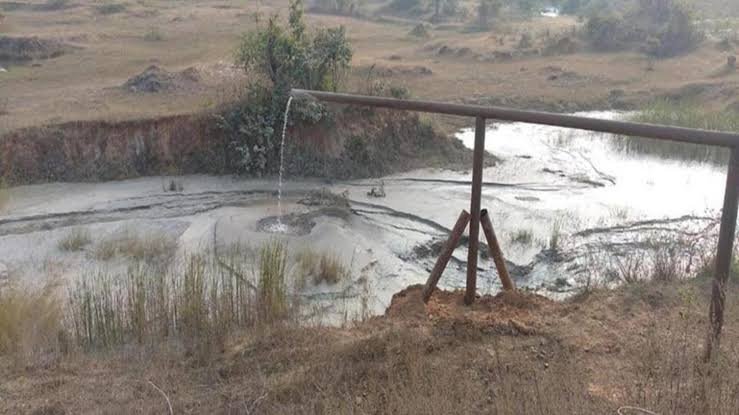
The Nagpur Bench of the Bombay High Court has sought a response from the district collector over alleged unscientific fly ash dumping at Nandgaon, near the Pench River, bringing renewed attention to environmental risks facing farms, water sources and communities around Khaparkheda.
High Court Steps In Over Nandgaon Fly Ash Concerns
The Nagpur Bench of the Bombay High Court has directed the Nagpur district collector to respond within two weeks to allegations concerning fly ash dumping at Nandgaon in the Khaparkheda area.
The direction was issued by a division bench comprising Justices Anil Kilor and Rajnish Vyas while hearing a suo motu public interest litigation. The case was initiated after reports raised concerns about the handling of fly ash at the site and its possible environmental consequences.
The court has also asked the administration to explain what action was taken after an earlier official inspection of the site.
Importantly, the High Court has not made a final finding that fly ash from Nandgaon has entered or polluted the Pench River. The proceedings are currently focused on examining the allegations, inspection findings and response of the concerned authorities.
That distinction is important because the environmental concerns remain under judicial examination.
Why the Pench River Is Central to the Case
One of the biggest concerns surrounding the Nandgaon fly ash issue is the site’s proximity to the Pench River.
Amicus curiae Arnav Pansare, who was appointed to assist the court, inspected the location and submitted geo-referenced and satellite images. According to his submission, fly ash at the site could potentially be washed towards the Pench River during monsoon rainfall.
The concern is particularly serious because rivers in the Pench and Kanhan systems are important water resources for communities in and around Nagpur district.
Environmental groups have raised similar concerns in earlier years about ash entering local water systems during heavy rain or following failures of ash containment infrastructure.
Previous reporting from 2022 also documented concerns that ash remaining at Nandgaon during the monsoon could eventually reach the Pench River through local drainage systems.
However, whether contamination has actually occurred in the present case still requires scientific testing and official assessment.
MPCB Inspection Adds Another Layer to Fly Ash Dispute
The Maharashtra Pollution Control Board has already examined conditions around Nandgaon.
In August 2026, an MPCB-led team, accompanied by officials from departments including agriculture and water supply, visited the area following complaints regarding fly ash disposal.
The pollution control board directed Khaparkheda Thermal Power Station to take corrective steps and improve its ash bund management system. Officials reportedly identified deficiencies related to infrastructure required for handling ash discharge, including concerns surrounding lagoons and lining systems.
During that particular inspection, officials did not observe discharge entering the river, according to the report. Water samples were collected for examination.
This creates an important distinction between environmental risk and confirmed pollution.
The court proceedings are significant because they could bring together inspection findings, photographic evidence, administrative reports and regulatory compliance records to determine what actually happened.
Nandgaon Has Faced Similar Fly Ash Problems Before
The current controversy is not the first time Nandgaon has been associated with concerns over fly ash disposal.
Maharashtra State Power Generation Company, commonly known as Mahagenco, acquired hundreds of acres at Nandgaon decades ago for ash disposal. Large sections reportedly remained unused for long periods, during which local farmers continued cultivating portions of the land.
A major controversy emerged in 2021 when an ash pond incident caused concerns over agricultural damage and triggered protests by residents and farmers.
In 2022, the Maharashtra Pollution Control Board issued a show-cause notice to the Khaparkheda Thermal Power Station over issues related to fly ash removal from Nandgaon and environmental compliance.
The history of repeated disputes matters because the present High Court intervention is not taking place in isolation.
It raises a broader question about whether previous regulatory directions resulted in durable improvements to fly ash management around thermal power facilities in the Nagpur region.
Fly Ash Management Is a Wider Environmental Challenge
Fly ash is generated when coal is burned in thermal power plants. India produces large quantities of ash because coal continues to play a major role in electricity generation.
The environmental challenge is therefore not simply to store fly ash safely, but to reduce long-term dumping by putting the material to productive use.
The Ministry of Environment, Forest and Climate Change’s Ash Utilisation Notification, 2021 placed primary responsibility on coal and lignite-based thermal power plants to ensure 100 percent utilisation of ash in an environmentally responsible manner under prescribed timelines.
Fly ash can be used in products and projects including bricks, blocks, cement-related materials and certain construction activities.
The regulations are designed partly to reduce dependence on large ash disposal areas and limit environmental risks associated with accumulated ash.
For Vidarbha, where coal-based power generation has a substantial presence, the Nandgaon dispute highlights how national rules eventually depend on effective implementation at the local level.
Why the Nandgaon Order Matters for Vidarbha Farmers
For communities around thermal power installations, fly ash management is not only an industrial or environmental policy issue.
It can directly affect agriculture.
Reports surrounding the Nandgaon site have alleged that ash-laden slurry entered agricultural fields following a breach, damaging crops and creating difficulties for farmers. The High Court report also referred to allegations of extensive crop damage following the movement of slurry from the containment area.
Agricultural land exposed to industrial waste may require detailed soil and water testing before the extent of any damage can be established.
For farmers, however, even temporary crop losses can create immediate financial consequences.
This is one reason the collector’s response could become important. It may clarify whether agricultural losses were formally assessed, what remedial measures were ordered and whether agencies responsible for environmental compliance acted after inspecting the affected area.
The case could therefore become relevant beyond Nandgaon for villages located around other power stations and ash disposal sites in Vidarbha.
Court Scrutiny Could Strengthen Environmental Accountability
The Nagpur Bench has not yet determined responsibility or concluded that the Pench River has been polluted.
What it has done is demand greater clarity.
By asking what action followed the administration’s inspection report, the court is focusing attention on a familiar problem in environmental governance: whether inspections actually result in corrective action.
A committee report has limited value if serious findings are not followed by enforcement, remediation or preventive measures.
The court’s scrutiny may also help establish whether existing fly ash management systems at Nandgaon are adequate for monsoon conditions.
This is particularly important because heavy rainfall can increase the risk of slurry movement, bund overflow and runoff from poorly managed disposal areas.
For Vidarbha, the larger significance of the proceedings lies in accountability. Thermal power remains economically important to the region, but electricity generation must operate alongside safeguards for farms, rivers, groundwater and neighbouring communities.
The collector’s response is likely to provide the next important set of facts in the case.
Key Takeaways
- The Nagpur Bench of the Bombay High Court has asked the district collector to respond within two weeks regarding alleged unscientific fly ash dumping at Nandgaon.
- The court has not yet concluded that fly ash from the site has polluted the Pench River.
- MPCB officials earlier inspected the area and directed Khaparkheda Thermal Power Station to improve corrective measures and fly ash management infrastructure.
- The case matters for Vidarbha because it connects thermal power generation with agricultural protection, water security and enforcement of environmental regulations.
Frequently Asked Questions
What is the Nandgaon fly ash case?
The case concerns allegations of improper fly ash dumping and management at Nandgaon near the Khaparkheda Thermal Power Station. The Nagpur Bench of the Bombay High Court is examining the issue through a suo motu public interest litigation.
Has the High Court confirmed pollution in the Pench River?
No. The High Court has not recorded a final finding that fly ash from Nandgaon is entering or contaminating the Pench River. The administration has been asked to provide information and explain action taken following inspections.
Why is fly ash considered an environmental concern?
Improperly managed fly ash can create risks to land and water systems, particularly when accumulated ash or slurry escapes containment areas. Indian regulations therefore require thermal power plants to manage and utilise ash under prescribed environmental rules.
What happens next in the Nandgaon case?
The Nagpur district collector has been directed to file a response detailing the administration’s position and the action taken on an earlier inspection report. That response could help the court determine whether further environmental or regulatory action is necessary.
(Nandgaon fly ash dumping, Nagpur Bench Bombay High Court, Pench River pollution, Khaparkheda Thermal Power Station, Mahagenco fly ash, MPCB Nagpur, Vidarbha environment news, fly ash management Maharashtra, Nandgaon farmers, Nagpur environmental news)









Leave a comment