

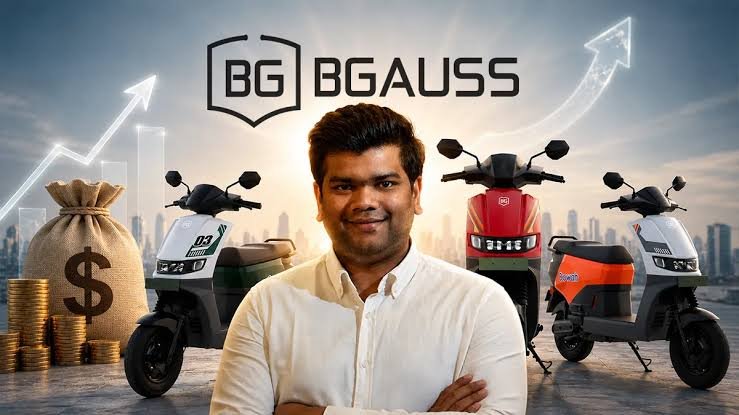
BGauss has raised ₹110 crore in fresh funding, highlighting continued investor interest in India’s electric two-wheeler market. The fundraise comes as EV registrations rise sharply, competition intensifies and manufacturers look beyond early adopters toward mainstream Indian consumers.
BGauss Raises ₹110 Crore in Fresh Funding
Electric scooter maker BGauss has raised ₹110 crore in a fresh funding round, according to reports published on August 20. The round was led by founder Hemant Mahendrakumar Kabra, with participation from existing investor Bharat Value Fund and other investors.
Kabra contributed ₹50 crore, while Bharat Value Fund invested ₹44 crore. Adesh Realtor LLP and Maithan Alloys contributed ₹10 crore and ₹6 crore respectively.
Following the transaction, BGauss is estimated to have a post-money valuation of between ₹1,000 crore and ₹1,100 crore. The company plans to use the fresh capital for growth, product development, operational scaling and market expansion.
The fundraise is significant because it comes at a time when India’s electric two-wheeler market is showing strong sales growth but also becoming increasingly competitive.
Electric Two-Wheeler Sales Show Strong Momentum
The BGauss funding comes against a backdrop of rising EV adoption in India.
According to data reported from the Federation of Automobile Dealers Associations, India’s overall electric vehicle retail sales reached a record 327,901 units in July 2026, up 66% year-on-year. EVs accounted for nearly 12% of overall vehicle retail sales during the month.
Two-wheelers remain central to this transition because they are among India’s most widely used personal mobility options.
July was particularly strong for the broader two-wheeler market. Retail sales reached about 18.18 lakh units, up 28.25% from July 2025, while electric two-wheelers reached a record 11.24% share of the overall two-wheeler market, according to FADA data reported by industry publications.
This gives investors a much larger market opportunity than the early phase of India’s EV story, when electric scooters were largely treated as a niche category.
Why Investors Are Still Funding Electric Scooter Companies
The BGauss round suggests investors continue to see room for growth in electric two-wheelers despite intense competition.
The sector now includes established automotive companies as well as newer EV-focused manufacturers. Companies such as TVS Motor, Bajaj Auto and Ather Energy have built significant positions, while newer players are competing through pricing, product design, range, technology and dealership expansion.
For investors, this creates both an opportunity and a challenge.
The opportunity comes from the possibility that electric scooters will take a larger share of India’s enormous two-wheeler market. The challenge is that gaining that share requires substantial spending on manufacturing, distribution, service networks, technology and customer acquisition.
A ₹110 crore investment therefore gives BGauss additional financial capacity at a time when scale is becoming increasingly important.
BGauss Funding Comes as Competition Intensifies
The Indian electric scooter market is no longer dominated by a small group of startups.
Traditional automobile manufacturers have entered the category with established dealer networks and manufacturing capabilities. At the same time, dedicated EV companies continue to launch new products and expand their retail presence.
July sales illustrate the intensity of this competition. TVS Motor and Bajaj Auto were among the leading electric two-wheeler manufacturers, while Ather and other EV-focused companies also maintained significant market positions.
This changes what investors are looking for.
A company cannot depend only on the argument that India’s EV market is growing. It also needs to demonstrate that it can capture customers, maintain product quality, build distribution and manage costs.
That makes fresh capital increasingly important for companies trying to move from an early-stage brand to a national-scale manufacturer.
The Real Opportunity Is Beyond Metro Cities
One of the biggest opportunities for electric two-wheelers lies outside India’s largest urban markets.
Electric scooters can be particularly relevant in Tier-2 and Tier-3 cities because many consumers use two-wheelers for daily commuting, education, local business and short-distance travel.
Lower running costs are another consideration. Electric vehicles have fewer mechanical components than conventional internal-combustion vehicles, although the overall ownership equation depends on the purchase price, financing, charging arrangements, battery life, maintenance and electricity costs.
For EV manufacturers, reaching these markets requires more than launching products online.
Customers in smaller cities may want access to physical dealerships, service centres and reliable after-sales support before switching from petrol vehicles.
That means companies capable of building distribution networks across smaller cities could have an important advantage as EV adoption broadens.
Funding Does Not Guarantee Long-Term Success
The ₹110 crore fundraise is a positive development for BGauss, but funding alone does not establish whether the business will become a major EV manufacturer.
Electric two-wheelers remain a competitive and capital-intensive business.
Manufacturers need to spend on product development, manufacturing capacity, supply chains, battery technology, dealerships and service infrastructure. They also have to manage changing consumer expectations around range, charging time, performance and pricing.
The wider EV market has already shown that sales growth can be uneven between companies.
The current market leaders are competing aggressively, and some companies are attempting to diversify beyond electric scooters. Ola Electric, for example, recently expanded into energy storage products, seeking additional uses for its battery manufacturing capabilities.
For BGauss, the ability to convert fresh funding into sustained sales growth and a stronger market position will therefore be more important than the size of the funding round itself.
What BGauss Funding Says About India’s EV Market
The timing of the investment points to a broader change in investor thinking.
India’s EV market has moved beyond the question of whether consumers will buy electric vehicles. The more important questions now involve which companies can scale profitably, which brands can build customer trust and which manufacturers can compete across different parts of the country.
The growth in electric two-wheeler registrations suggests that consumer acceptance is improving. July’s record 11.24% electric penetration in two-wheelers is particularly important because it shows EVs are moving into the mainstream rather than remaining a niche product.
However, petrol two-wheelers still accounted for the overwhelming majority of the market in July.
That leaves a large potential customer base for EV manufacturers, but converting those customers will require competitive prices, dependable products and convenient ownership.
EV Growth Could Reshape India’s Two-Wheeler Industry
The transition to electric mobility is likely to affect more than vehicle manufacturers.
Battery suppliers, charging infrastructure companies, component manufacturers, financing firms, software providers and service businesses can all become part of the expanding EV ecosystem.
For smaller Indian cities, the shift could also create new opportunities in dealerships, servicing, battery maintenance and charging infrastructure.
The growth of electric two-wheelers could therefore become a broader industrial transition rather than simply a change in the type of scooter consumers purchase.
BGauss’s latest funding is one piece of that larger story. Its significance lies less in the ₹110 crore figure alone and more in what the investment indicates about continued confidence in India’s long-term electric mobility opportunity.
Key Takeaways
- BGauss has raised ₹110 crore in fresh funding from its founder, Bharat Value Fund and other investors.
- The company is estimated to have a post-money valuation of ₹1,000 crore to ₹1,100 crore.
- India’s electric two-wheeler penetration reached a record 11.24% of the two-wheeler market in July 2026.
- Future EV winners will need to combine strong products with competitive pricing, distribution, service networks and financial discipline.
FAQ
How much funding has BGauss raised?
BGauss has raised ₹110 crore in a fresh funding round announced in August 2026. The round included investment from founder Hemant Mahendrakumar Kabra, Bharat Value Fund and other investors.
What will BGauss use the funding for?
The capital is expected to support the company’s growth plans, product development, operational scaling and expansion of its market presence.
How fast is India’s electric two-wheeler market growing?
Electric two-wheeler registrations and retail sales have been growing strongly in 2026. FADA data reported for July showed electric two-wheelers reaching a record 11.24% share of India’s overall two-wheeler retail market.
Why are electric two-wheelers important for India’s EV transition?
Two-wheelers are widely used for daily mobility in India, including in smaller cities and towns. Their relatively lower running requirements and suitability for short-distance travel make them an important category for wider EV adoption.








Leave a comment