

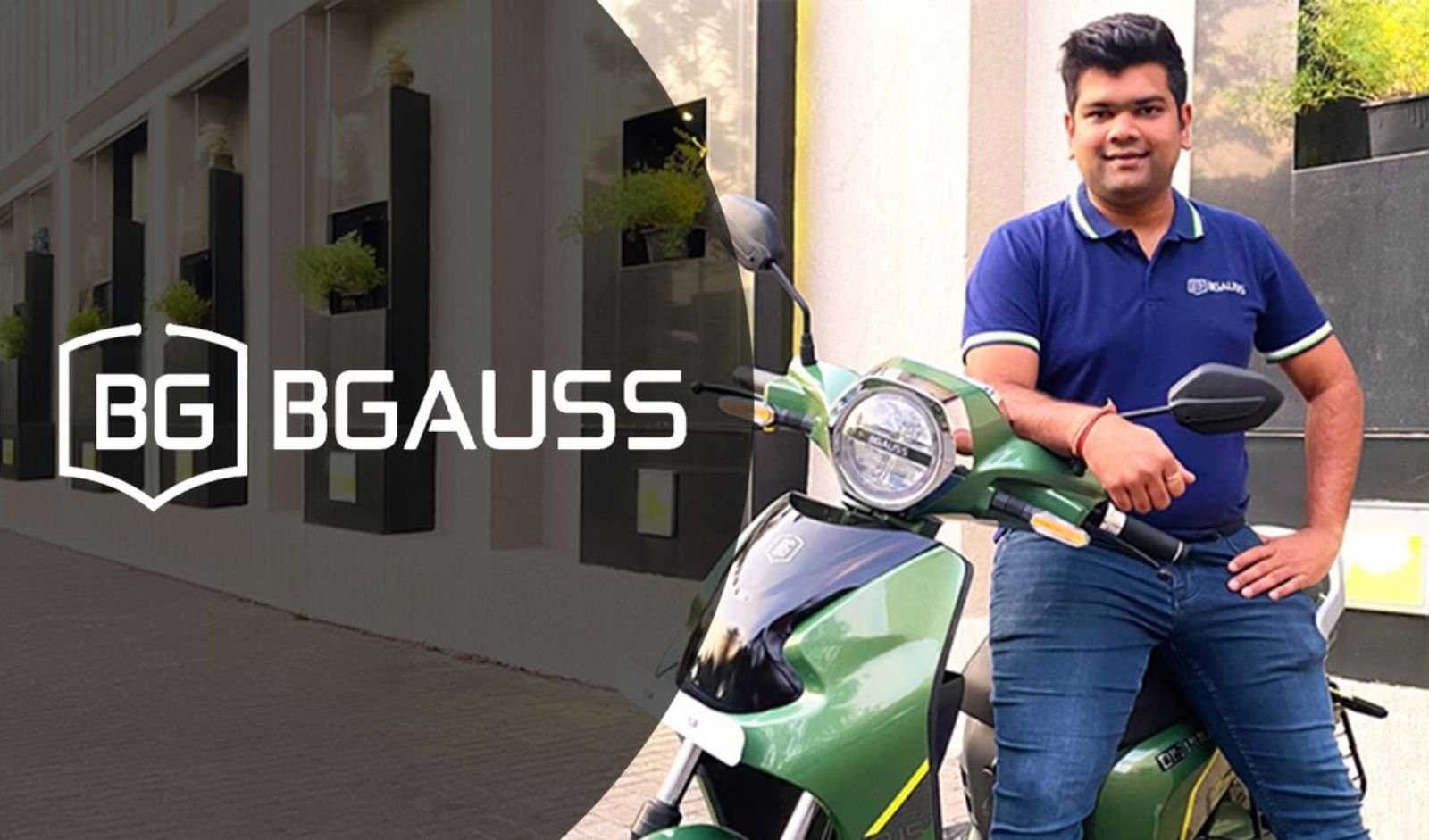
BGauss has raised ₹110 crore in a Series D funding round, giving the electric two-wheeler maker fresh capital to expand operations, strengthen its product portfolio and pursue growth. The investment comes as India’s electric scooter market reaches record sales but competition intensifies.
BGauss Raises ₹110 Crore in Series D Funding
Electric two-wheeler manufacturer BGauss has raised ₹110 crore in a Series D funding round led by founder Hemant Mahendrakumar Kabra, with participation from existing investor Bharat Value Fund and other investors. The round was reported on August 20, 2026, making it a current development in India’s EV startup sector.
According to a regulatory filing cited by Entrackr, BGauss approved the allotment of 17,26,846 Series D compulsorily convertible preference shares at ₹637 per share. Kabra invested ₹50 crore, Bharat Value Fund contributed ₹44 crore, while Adesh Realtor LLP and Maithan Alloys invested ₹10 crore and ₹6 crore respectively.
The transaction puts BGauss at an estimated post-money valuation of around ₹1,000 crore to ₹1,100 crore, although the final valuation could change if the company completes additional fundraising as part of a larger round.
The fresh capital is expected to support operations, product development and expansion as BGauss competes for a larger share of India’s rapidly growing electric two-wheeler market.
July EV Sales Show Why Investors Are Watching
The timing of the BGauss funding is important because India’s electric two-wheeler market has reached a new scale.
According to FADA data reported by automotive publications, electric two-wheeler registrations reached 2,04,362 units in July 2026. That was an 88.32% increase from 1,08,516 units in July 2025. Electric two-wheelers accounted for 11.24% of the overall two-wheeler retail market during the month, compared with 7.65% a year earlier.
The broader two-wheeler market also recorded a strong July. Retail sales reached 18,18,289 units, up 28.25% year on year and marking the segment’s best-ever July performance, according to FADA data reported by DriveSpark.
These numbers show why electric scooters are attracting continued investor attention. The category is no longer limited to a small group of early adopters. More than two lakh electric two-wheelers were registered in a single month, while petrol models still accounted for the overwhelming majority of sales.
That leaves a large market for EV manufacturers to compete for.
BGauss Is Growing, But Its Market Share Remains Small
BGauss’s own numbers provide a more measured picture of its position.
The company recorded 5,518 retail registrations in July 2026, nearly three times its registrations in the same month last year. However, that represented only around 0.3% of India’s electric two-wheeler market during the month.
That distinction matters.
A company can record rapid year-on-year growth while still having a relatively small market share. For BGauss, the next challenge is therefore not simply to maintain growth but to convert that growth into a larger and more durable position in the market.
The company is competing against manufacturers with significantly larger sales volumes and established distribution networks.
July’s electric two-wheeler data showed TVS Motor and Bajaj Auto leading the segment, followed by Ather and other manufacturers.
BGauss therefore has to compete in a market where both traditional automobile companies and EV-focused startups are expanding aggressively.
Competition Is Moving Beyond Electric Scooters
India’s EV two-wheeler market has changed considerably over the past few years.
Companies such as TVS Motor and Bajaj Auto bring decades of manufacturing and dealership experience to the electric segment. Ather and Ola Electric have built dedicated EV businesses, while Hero MotoCorp has expanded its electric presence through Vida.
This creates a difficult environment for smaller manufacturers.
Customers increasingly have more choices across price points and product categories. They can compare range, charging time, performance, software features, service availability and financing before buying an electric scooter.
For manufacturers, having a technically capable product is no longer enough.
A company also needs reliable after-sales service, spare parts availability and a strong retail network. These factors can become especially important outside major cities, where consumers may be less willing to purchase a vehicle if authorised service support is difficult to access.
The ₹110 crore raised by BGauss can therefore give the company more room to invest in the areas needed for scale.
Product Development Will Be Critical for BGauss
BGauss was founded in 2020 by Hemant Kabra and focuses on electric scooters combining design with technology features.
The company has previously highlighted features including AI-enabled systems, IoT integration, fast charging and low-maintenance requirements.
However, the electric scooter market is becoming increasingly feature-driven.
Consumers are comparing products on practical factors such as battery capacity, real-world range, charging infrastructure, warranty, service costs and long-term reliability. Technology features can help differentiate a scooter, but they need to translate into a useful ownership experience.
BGauss’s previous funding has also been directed towards manufacturing, research and development, marketing and dealership expansion. In January 2025, the company raised ₹161 crore from Bharat Value Fund, with plans to expand its dealership network substantially.
The latest funding round gives the company another opportunity to strengthen that expansion strategy.
Smaller Cities Could Be Important to EV Growth
One of the biggest opportunities for electric two-wheelers lies beyond India’s largest metropolitan markets.
Two-wheelers are already central to everyday transportation across Tier-2 and Tier-3 cities. Commuters use scooters and motorcycles for work, education, household errands, local businesses and short-distance travel.
This makes electric scooters potentially relevant to a much broader consumer base.
But reaching these customers requires a physical network. A buyer in a smaller city may want a nearby showroom, service centre and technician before choosing an EV over a petrol scooter.
That is why dealership expansion can be just as important as advertising or product launches.
BGauss had previously targeted a major expansion of its dealership network, with plans reported in 2025 to move from 120 locations towards 500 dealerships and more than 1,000 customer touchpoints.
If the company can use fresh capital to deepen its presence across regional markets, it could potentially reach customers who are still at the early stage of considering an electric vehicle.
EV Funding Is Becoming More Selective
The latest BGauss round should not be interpreted as evidence that investors are funding every EV startup indiscriminately.
The Indian startup funding environment has become more focused on companies that can demonstrate actual business traction, market demand and a credible route to scale.
BGauss’s funding arrives alongside a strong increase in electric two-wheeler registrations, which provides a favourable market backdrop. At the same time, its relatively small 0.3% market share shows that the company still has significant ground to cover.
This combination makes the funding particularly relevant.
Investors appear willing to provide growth capital in the EV sector, but the real test for companies such as BGauss will be whether that capital can translate into higher sales, stronger distribution and sustainable economics.
The size of a funding round alone does not determine a company’s future.
What the Funding Says About India’s Two-Wheeler Market
The BGauss funding highlights a broader shift taking place in India’s automobile industry.
Electric two-wheelers are gaining market share, but petrol vehicles still dominate. In July 2026, electric two-wheelers represented 11.24% of total two-wheeler retail registrations, meaning almost nine out of every ten registered two-wheelers still used other powertrains.
That remaining market is the opportunity.
The next phase of EV growth will depend on whether manufacturers can convince mainstream consumers to switch. Price will remain important, but so will financing, battery confidence, service availability, charging convenience and resale expectations.
For startups, this creates a difficult balance. They need to spend enough to build scale while controlling costs in a market where established manufacturers have considerable advantages.
BGauss’s ₹110 crore raise gives it additional resources to attempt that balance.
Why the Next Phase Could Be More Competitive
India’s electric two-wheeler market is entering a stage where scale could become increasingly important.
The July numbers show that demand is expanding rapidly, while the presence of TVS, Bajaj, Ather, Ola, Hero and other manufacturers means customers have more choices than they did several years ago.
For BGauss, the immediate opportunity is to build on its registration growth and convert it into sustained market share.
For the wider industry, the funding indicates that investors continue to see long-term potential in electric mobility, even as they assess companies more closely on execution.
The Indian two-wheeler market is large enough to support multiple winners. But the companies that ultimately succeed are likely to be those that can combine competitive products with manufacturing scale, dependable service and strong distribution.
Key Takeaways
- BGauss has raised ₹110 crore in a Series D round led by founder Hemant Mahendrakumar Kabra.
- India’s electric two-wheeler registrations reached 2,04,362 units in July 2026, giving EVs a record 11.24% share of the two-wheeler market.
- BGauss recorded 5,518 retail registrations in July, nearly three times its year-ago figure, but held about 0.3% of the electric two-wheeler market.
- The company’s next challenge will be converting fresh capital and sales growth into stronger market share, distribution and long-term business performance.
FAQ
How much funding has BGauss raised in its latest round?
BGauss has raised ₹110 crore in a Series D funding round. Founder Hemant Mahendrakumar Kabra invested ₹50 crore, Bharat Value Fund invested ₹44 crore, while Adesh Realtor LLP and Maithan Alloys invested ₹10 crore and ₹6 crore respectively.
What is BGauss’s valuation after the funding?
The latest transaction puts the company’s estimated post-money valuation at approximately ₹1,000 crore to ₹1,100 crore. The final figure could change if the company raises additional capital as part of a larger round.
How large is India’s electric two-wheeler market?
India recorded 2,04,362 electric two-wheeler registrations in July 2026, up 88.32% year on year. Electric two-wheelers accounted for 11.24% of the overall two-wheeler retail market during the month.
What does BGauss need to do to compete with larger EV brands?
The company will need to build sustained sales growth while expanding product offerings, manufacturing capabilities, dealerships and after-sales service. Its ability to gain market share against established manufacturers and larger EV specialists will be a key measure of its progress.










Leave a comment