

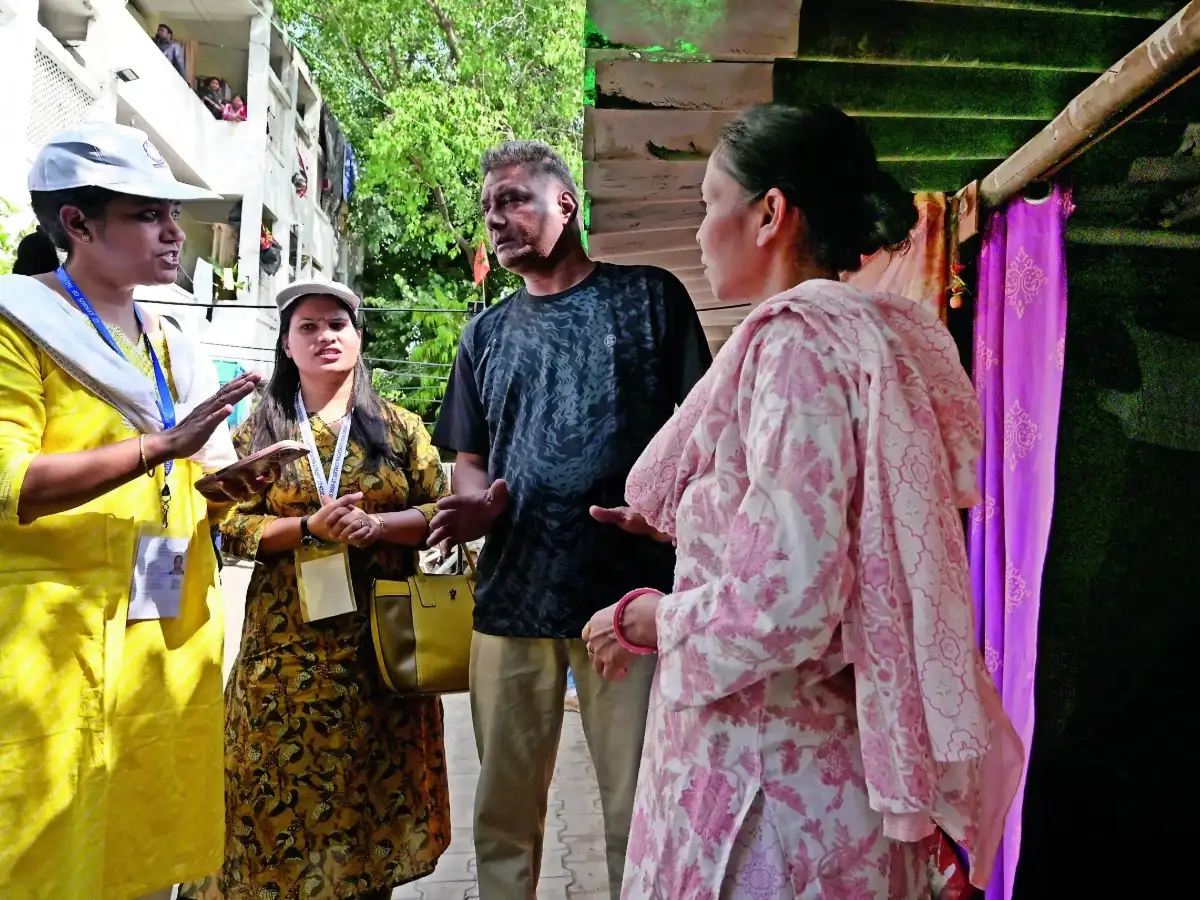
India’s Census 2027 is moving into its next phase, introducing digital data collection and an optional online self-enumeration facility for households. With population counting beginning in selected states, residents of smaller cities should understand the process, important dates, information being collected and how to participate.
Census 2027: India’s First Digital Census Moves Forward
The Census 2027 exercise is entering an important stage as the government prepares to collect updated population data across the country. Conducted by the Office of the Registrar General and Census Commissioner under the Ministry of Home Affairs, the census will provide information about India’s population, households, social conditions and demographic changes.
India’s previous population census was conducted in 2011. The 2021 Census was postponed, making the upcoming exercise particularly important for updating official demographic information.
According to the government, Census 2027 is being conducted in two phases. The first phase, known as the Houselisting and Housing Census, focuses on residential structures, housing conditions and household facilities. The second phase, called Population Enumeration, will collect information about individuals and their demographic and socio-economic characteristics.
The exercise is being conducted using digital technology for the first time, with mobile applications for enumerators and an online self-enumeration facility for residents.
Census 2027 Schedule: Important Dates Residents Should Know
The government has introduced a staggered schedule for Population Enumeration, with selected states following an earlier timetable.
As announced by the Ministry of Home Affairs on November 16, 2026, self-enumeration has started in Uttar Pradesh, Punjab, Goa and non-snow-bound areas of Uttarakhand.
The important dates for these states and areas are:
- November 16 to November 30, 2026: Online self-enumeration.
- December 1, 2026 to January 4, 2027: Door-to-door population enumeration.
- January 5 to January 9, 2027: Revisional round.
- January 5, 2027: Reference date for these areas.
For the remaining states and Union Territories, the schedule is different:
- January 10 to January 24, 2027: Self-enumeration window.
- January 25 to February 28, 2027: Door-to-door population enumeration.
- March 1 to March 5, 2027: Revisional round.
- March 1, 2027: Reference date.
These dates are important because residents should follow the schedule applicable to their state rather than assuming that population enumeration will begin everywhere on the same day.
What Is Self-Enumeration and How Can Residents Participate?
One of the major changes introduced in Census 2027 is the option of self-enumeration.
Under this facility, residents can submit their household information online instead of waiting for an enumerator to collect the initial details. The facility is designed to make data collection more convenient and reduce the time required for the exercise.
For the November 16 to November 30 window, eligible residents in Uttar Pradesh, Punjab, Goa and non-snow-bound areas of Uttarakhand can access the official portal at se.census.gov.in.
The process involves using a mobile number, preferably the one registered during Phase I, along with basic household details. Residents are required to answer 40 notified questions covering household and individual particulars.
After successful submission, the system generates a unique Self-Enumeration ID, commonly called an SE ID.
This identification number should be shared with the census enumerator during the subsequent household visit to complete the process.
Self-enumeration is optional. Residents who do not use the online facility will still be covered through the regular door-to-door enumeration process.
The facility is available in 16 Indian languages, making it accessible to people from different linguistic backgrounds.
What Information Will Census Enumerators Collect?
The census is not simply a count of how many people live in India. It is a detailed exercise designed to understand the country’s population structure and living conditions.
The two phases collect different categories of information.
During the first phase, the Houselisting and Housing Census collects details related to residential buildings and household conditions.
These include information about:
- The condition and characteristics of residential houses.
- Household facilities and basic amenities.
- Drinking water and sanitation arrangements.
- Electricity and other household facilities.
- Assets possessed by households.
The second phase focuses on individuals and their demographic and socio-economic characteristics.
Information collected during Population Enumeration will cover areas such as age, education, migration, fertility and other notified individual particulars.
The government has also confirmed that caste enumeration will be included in the second phase of Census 2027.
Together, these details will help create a more comprehensive picture of India’s changing population and household conditions.
Why Census 2027 Matters for Tier-2 and Tier-3 Cities
For smaller cities and towns, the census has significance beyond the total population figure.
Cities such as Nagpur, Nashik, Indore, Bhopal, Jaipur, Lucknow and other growing urban centres have experienced changes in housing, migration, employment and infrastructure requirements over the years.
Accurate population information can help governments understand these changes and plan public services accordingly.
For example, population and household data can support decisions related to schools, hospitals, drinking water facilities, sanitation systems and public infrastructure.
Migration information can also help authorities understand how people move between rural areas, smaller cities and metropolitan centres for education and employment.
In rapidly expanding urban areas, updated household information can help identify changes in residential patterns and the demand for basic services.
However, the census itself does not automatically approve new infrastructure projects or guarantee additional government funding for a particular city. Its importance lies in providing reliable statistical information that can support future planning and policy decisions.
For smaller municipalities and district administrations, having updated population information is particularly relevant when assessing long-term development requirements.
How Digital Census Collection Could Change the Process
Traditional census operations have relied heavily on paper-based forms and manual data management. Census 2027 is introducing a digital approach to improve the collection and management of information.
Enumerators will use mobile applications to record household and population details. The government has also deployed digital platforms, including the Census Management and Monitoring System, to monitor the exercise.
Self-enumeration adds another option for residents who prefer to submit information online.
The digital approach is expected to improve the efficiency of data collection and reduce certain administrative challenges associated with handling large volumes of paper records.
It also creates an opportunity to make the process more accessible to households that are comfortable using digital services.
However, digital participation does not eliminate the need for field visits. Enumerators will continue visiting households to complete the process and cover residents who do not use self-enumeration.
The success of this approach will depend on accurate data entry, proper training of census personnel and cooperation from residents across urban and rural areas.
Is Census Information Confidential?
Data privacy is an important concern whenever households are asked to provide personal information.
The government has stated that information collected under the Census Act, 1948, will remain strictly confidential and will be used exclusively for statistical purposes and development planning.
Individual household responses are not intended to be publicly disclosed as personal records.
Residents should also ensure that they participate through official census channels and cooperate with authorised enumerators.
The official self-enumeration portal is se.census.gov.in. People should avoid sharing sensitive information with unknown individuals or responding to suspicious messages claiming to represent census authorities.
If residents have doubts about the process, they should seek clarification through official government census channels rather than relying on unverified social media messages.
What Residents Should Do Before the Census Visit
Residents can prepare for the upcoming population enumeration by understanding the applicable dates and keeping their household information accurate.
Those eligible for self-enumeration can use the official portal during their state’s notified window. After completing the online submission, they should retain the generated SE ID for the enumerator’s visit.
Households that do not complete self-enumeration should cooperate with authorised census personnel during door-to-door visits.
Providing accurate information is important because incomplete or incorrect responses can affect the quality of the final population data.
Residents should also understand that self-enumeration is optional and that the official door-to-door process will continue.
As India moves towards completing Census 2027, participation from smaller cities, towns and rural communities will be essential to building a reliable picture of the country’s population.
Key Takeaways
- Census 2027 is India’s first census to introduce digital data collection and an optional self-enumeration facility.
- Self-enumeration for Uttar Pradesh, Punjab, Goa and non-snow-bound areas of Uttarakhand began on November 16 and will continue until November 30, 2026.
- The remaining states and Union Territories will have their self-enumeration window from January 10 to January 24, 2027.
- Census information will help support demographic research, public infrastructure planning and government development policies.
Frequently Asked Questions
1. When will Census 2027 take place in India?
Census 2027 is being conducted in two phases. The first phase, covering house listing and housing information, took place between April and September 2026. Population Enumeration is being conducted on a staggered schedule, with selected states beginning earlier and the remaining states scheduled from January 25 to February 28, 2027.
2. Can residents complete Census 2027 online?
Yes. The government has introduced an optional self-enumeration facility through the official portal, se.census.gov.in. Residents can submit household details during their state’s designated self-enumeration period and receive a unique SE ID.
3. Is self-enumeration compulsory for Indian households?
No. Self-enumeration is optional. Households that do not complete the online process will still be covered by census enumerators through door-to-door visits.
4. Why is Census 2027 important for smaller cities?
Census information can help governments understand population growth, migration, housing conditions and demographic changes in smaller cities. These statistics can support planning for schools, healthcare, sanitation, drinking water and other public services.









Leave a comment