

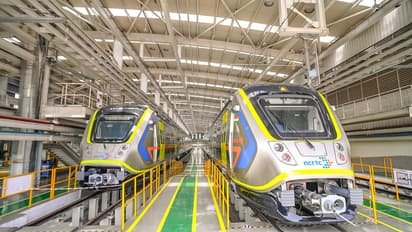
The Meerut Metro and Namo Bharat Corridor launch marks a major shift in how people travel between Delhi and nearby NCR towns. The project reduces travel time, improves reliability, and integrates regional mobility like never before.
The Meerut Metro and Namo Bharat Corridor are redefining daily commuting for thousands across the National Capital Region. For residents of Meerut, Ghaziabad, Modinagar, and surrounding towns, this is not just a new train service. It is a structural change in how the region moves for work, education, and business.
What Is the Meerut Metro and Namo Bharat Corridor?
The Meerut Metro is integrated within the Delhi Meerut Regional Rapid Transit System, now branded as Namo Bharat. The corridor connects Delhi to Meerut over a high speed rail network designed for semi high speed regional travel. Unlike traditional metro systems that operate within a city, this corridor links cities across the NCR with faster acceleration, fewer stops, and modern rolling stock.
The Delhi Meerut RRTS corridor spans roughly 82 kilometers. It includes multiple stations across Delhi, Ghaziabad, and Meerut. A unique feature is the local Meerut Metro service that operates on the same infrastructure within Meerut city, providing urban connectivity along with regional connectivity.
This dual model allows both long distance commuters and city level passengers to use the system efficiently.
Travel Time Reduction for Daily Commuters
One of the biggest impacts of the Namo Bharat Corridor is travel time reduction. Earlier, commuting from Meerut to central Delhi by road could take two to three hours during peak traffic. With high speed regional trains, the same journey is expected to take under one hour once the full corridor is operational.
For towns like Modinagar and Muradnagar, which sit between Delhi and Meerut, connectivity improves dramatically. These areas previously depended heavily on road transport or slow conventional rail. Faster and predictable travel opens up new employment options in Delhi and Noida without relocation.
This time compression directly benefits salaried professionals, students attending colleges in Delhi NCR, and small business owners who depend on intercity movement.
Impact on Tier 2 and Tier 3 Town Development
The Meerut Metro and regional rapid transit system support balanced urban development across NCR. Tier 2 cities like Meerut gain stronger economic integration with Delhi. Property markets near stations typically witness increased demand because proximity to rapid transit reduces dependence on private vehicles.
Local markets in Ghaziabad and Meerut also stand to benefit. Retail activity often increases around major transit hubs due to higher footfall. Offices and co working spaces may expand into these towns as commute times become manageable for employees based in Delhi.
Over time, this reduces pressure on central Delhi real estate and encourages distributed growth across the region.
Integrated Transport and Multimodal Connectivity
A key feature of the Namo Bharat Corridor is multimodal integration. Stations are designed to connect with Delhi Metro lines, buses, and local transport systems. Seamless ticketing and platform integration reduce transfer friction for passengers.
For example, a commuter from Meerut can board a regional rapid train, switch to the Delhi Metro at a major interchange, and continue toward Gurugram or South Delhi without excessive delays. This network effect multiplies the utility of each individual system.
Better last mile connectivity in Meerut city through the Meerut Metro section further ensures that passengers do not depend entirely on autos or private cabs after arrival.
Environmental and Traffic Benefits
Road congestion between Delhi and Meerut has been a long standing issue. Heavy reliance on private cars, buses, and shared vehicles contributes to pollution and unpredictable travel times.
High capacity electric rail systems like the Namo Bharat trains shift a portion of that traffic to public transport. Over time, this can lower vehicular emissions and reduce pressure on highways such as NH 58.
If ridership scales as projected, the corridor could become a case study for sustainable regional mobility in India.
Challenges and Realistic Expectations
While the infrastructure is modern, adoption depends on pricing, frequency, and reliability. Ticket fares must remain competitive compared to buses and shared cabs. Train frequency during peak hours will determine whether commuters fully switch.
There is also a behavioral shift involved. Daily travelers who are used to road transport may take time to transition to a structured rail schedule. Parking facilities, feeder buses, and safety measures around stations will influence long term success.
Still, the structural advantage of speed and reliability gives the system a strong foundation.
Long Term Transformation of NCR Mobility
The Meerut Metro and Namo Bharat Corridor are part of a broader plan to connect multiple NCR cities through regional rapid transit. Similar corridors are proposed toward Alwar and Panipat.
If executed effectively, this model can change how NCR functions as a unified economic zone. People may choose to live in Tier 2 towns like Meerut while working in Delhi or Noida without sacrificing time or productivity.
For daily commuters, the launch is not just about a new train. It is about reclaiming hours lost in traffic and gaining access to wider opportunities.
Takeaways
• Travel time between Meerut and Delhi is significantly reduced, improving daily commute efficiency
• Tier 2 towns like Meerut and Modinagar gain stronger economic integration with NCR
• Multimodal connectivity enhances ease of travel across metro and regional networks
• Long term impact includes reduced road congestion and more balanced urban growth
FAQs
Q1. What is the difference between Meerut Metro and Namo Bharat trains?
Meerut Metro operates within Meerut city limits, while Namo Bharat trains provide high speed regional connectivity between Delhi and Meerut along the RRTS corridor.
Q2. How much time does the corridor save for commuters?
Once fully operational, travel time between Delhi and Meerut is expected to be under one hour, compared to two or more hours by road during peak traffic.
Q3. Who benefits the most from this project?
Daily office commuters, students, small business owners, and residents of Tier 2 towns who travel frequently to Delhi NCR benefit the most.
Q4. Will this reduce traffic on highways?
If ridership scales up, the shift from private vehicles to high capacity electric trains can help reduce congestion and vehicular emissions over time.











Leave a comment