

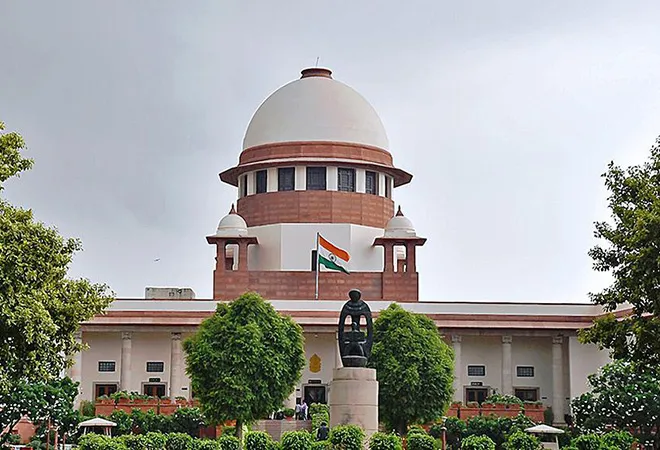
The Supreme Court’s latest observation on MLA disqualification has put the constitutional role of Assembly Speakers and the anti-defection law back in the spotlight. The Court has made clear that it cannot simply assume the Speaker’s role, raising important questions about political defections, legislative stability and judicial oversight in Indian states.
What did the Supreme Court say?
The Supreme Court on Wednesday, August 19, 2026, declined to accept the argument that it should itself disqualify Maharashtra MLAs who had shifted allegiance from the Uddhav Thackeray-led Shiv Sena faction to the Eknath Shinde faction. The Court said it could not assume the role assigned to the Speaker under the Tenth Schedule of the Constitution.
The observation came during the long-running Shiv Sena dispute, in which the Uddhav Thackeray faction has challenged the Maharashtra Assembly Speaker’s handling of disqualification petitions against MLAs aligned with Eknath Shinde.
The issue is important beyond Maharashtra. The Speaker of a state Legislative Assembly has a specific constitutional role in deciding disqualification petitions under the anti-defection law. The latest Supreme Court position reinforces the distinction between judicial review and the original decision-making authority assigned to the Speaker.
Why the Speaker’s role matters under the anti-defection law
The anti-defection provisions were introduced through the Tenth Schedule of the Constitution in 1985. Their broad purpose is to discourage elected representatives from switching political allegiance in ways that can destabilise governments or undermine the mandate on which they were elected.
Under the framework, certain forms of defection can result in an MLA being disqualified from the House. The Speaker or Chairman of the concerned legislature is responsible for deciding such petitions in the first instance.
This arrangement has repeatedly generated political and legal controversy because Speakers are elected members of the House and usually have political affiliations. Delays in deciding disqualification petitions have also become a recurring concern.
The Supreme Court itself has previously recognised that judicial review can apply to decisions made under the Tenth Schedule. However, that does not automatically mean that courts become the first authority to decide every disqualification petition.
The Maharashtra Shiv Sena dispute at the centre
The latest development is directly linked to the political crisis that split the Shiv Sena in 2022.
Eknath Shinde and a large group of Shiv Sena MLAs rebelled against then Chief Minister Uddhav Thackeray. The political crisis eventually led to the fall of the Maha Vikas Aghadi government and the formation of a government led by Shinde with BJP support.
Disqualification petitions were subsequently filed against MLAs from the rival factions. Maharashtra Assembly Speaker Rahul Narwekar later rejected the disqualification petitions involving members of the Shinde faction.
The Uddhav Thackeray faction challenged that decision before the Supreme Court. The case has since expanded into a broader constitutional dispute involving the meaning of the political party, the legislature party, the authority of the Speaker and the functioning of the anti-defection law.
During recent hearings, senior advocate Kapil Sibal, appearing for the Uddhav faction, argued that the Speaker had wrongly treated the legislative majority as equivalent to the political party. He relied on the Supreme Court’s earlier ruling in the Subhash Desai case, which dealt with the Shiv Sena split and the constitutional position of the political party and legislature party.
Does the ruling strengthen the power of Speakers?
The latest observation does not mean that Speakers have unlimited authority.
What it does show is that the Supreme Court is reluctant to replace the constitutional decision-making mechanism with direct judicial adjudication of disqualification petitions.
That distinction matters. If the judiciary were to directly decide every disqualification petition, it could blur the separation of powers between constitutional institutions.
At the same time, Speakers are not beyond judicial scrutiny. Their decisions can still be challenged on legal and constitutional grounds. The Supreme Court has previously intervened in disputes involving disqualification proceedings when constitutional or legal questions have arisen.
The real challenge, therefore, is finding a balance between allowing the Speaker to perform the role assigned by the Constitution and preventing prolonged delays from making the anti-defection law ineffective.
Why delays in disqualification cases are politically significant
Timing is one of the biggest issues surrounding the anti-defection law.
A government can change during the period in which a disqualification petition remains undecided. An MLA facing a disqualification petition may continue participating in legislative proceedings, voting on important matters and influencing the numerical strength of a government.
This becomes particularly significant when a government has a narrow majority.
The concern is not limited to Maharashtra. India has witnessed similar disputes in states where legislators switched political sides and disqualification petitions remained pending for extended periods.
In January 2026, for example, the Supreme Court stayed a Calcutta High Court order that had disqualified former West Bengal MLA Mukul Roy under the anti-defection law. The case raised another important question about how far courts can go when reviewing or replacing decisions made in the legislative sphere.
These cases show why the question of institutional responsibility remains central to the anti-defection debate.
What it means for state politics
The immediate political impact will be felt most strongly in Maharashtra, where the Shiv Sena dispute continues to influence the balance between rival factions.
But the larger significance is national.
Political parties in states frequently depend on closely balanced numbers in Legislative Assemblies. If defections occur, the timing of a Speaker’s decision can become politically consequential.
The latest Supreme Court position suggests that parties cannot simply expect the judiciary to bypass the Speaker and directly remove legislators. They must first pursue the constitutional mechanism established under the Tenth Schedule.
At the same time, the controversy keeps pressure on the political system to make disqualification proceedings faster and more predictable.
For voters, especially in states where governments change through coalition politics, the issue is ultimately about whether an elected representative can change allegiance without facing timely consequences under the law.
What could happen next?
The Supreme Court’s latest observation should not be interpreted as the final resolution of every question surrounding the Shiv Sena dispute.
The broader case involves several interconnected issues, including the status of the rival factions, the Election Commission’s recognition of the Shinde faction, the Speaker’s decisions and the interpretation of the Tenth Schedule.
The Court has also been examining arguments about the difference between a political party and its legislature party. The Uddhav faction has argued that a numerical majority among MLAs should not automatically determine which group represents the political party.
The final outcome could therefore have implications beyond the immediate Maharashtra dispute, particularly for how future political defections are handled by Speakers and reviewed by courts.
What the ruling means for ordinary voters
For voters, the issue may appear to be an internal fight between political factions. But it has a direct connection to democratic accountability.
An MLA is elected from a constituency on a particular political platform. When legislators change allegiance, questions arise over whether voters should have a say through a fresh election or whether the representative can continue in the House.
The anti-defection law was designed to address some of these concerns, but its effectiveness depends heavily on how quickly and consistently the rules are applied.
The Supreme Court’s latest position keeps the Speaker at the centre of that process while leaving open the possibility of judicial scrutiny where constitutional or legal errors are alleged.
Key Takeaways
- The Supreme Court has said it cannot simply assume the Speaker’s role in deciding MLA disqualification petitions.
- The Speaker remains the first constitutional authority for deciding disqualification matters under the Tenth Schedule.
- The Maharashtra Shiv Sena dispute has once again highlighted concerns about political defections and delays in deciding petitions.
- The wider case could influence how Speakers, political parties and courts handle future anti-defection disputes across Indian states.
FAQs
What is the Supreme Court’s latest Speaker ruling about?
The latest development concerns the Court’s refusal to directly assume the Maharashtra Assembly Speaker’s role and disqualify MLAs in the Shiv Sena dispute. The Court reiterated the Speaker’s role in deciding disqualification petitions under the Tenth Schedule.
Can the Supreme Court review a Speaker’s disqualification decision?
Yes. Although the Speaker is the first authority to decide a disqualification petition, Speaker decisions can be subject to judicial review in appropriate circumstances. The latest observation does not place the Speaker beyond the scrutiny of constitutional courts.
Why is the Maharashtra case important?
The case involves the political split between the Uddhav Thackeray and Eknath Shinde factions of the Shiv Sena. It raises broader questions about political defections, the authority of Speakers and the distinction between a political party and its legislature party.
What is the Tenth Schedule?
The Tenth Schedule contains India’s anti-defection provisions. Introduced through the 52nd Constitutional Amendment in 1985, it provides grounds on which legislators can be disqualified for defection from their political party, subject to constitutional exceptions.
(Internal keyword suggestions: Supreme Court Speaker ruling, Supreme Court latest news, MLA disqualification, anti-defection law India, Tenth Schedule Constitution, Maharashtra Shiv Sena case, Uddhav Thackeray Eknath Shinde case, Assembly Speaker powers, political defections India, state politics India)












Leave a comment