

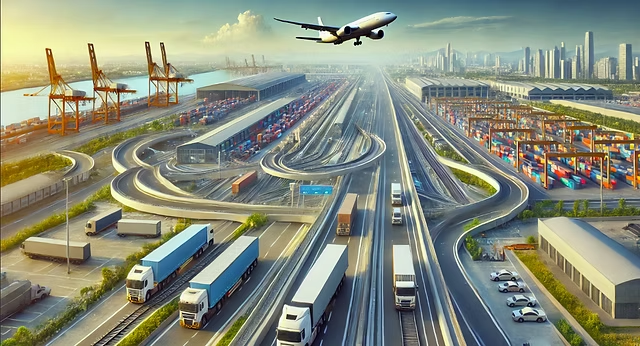
Logistics and warehousing hubs in Nagpur, Indore, and Lucknow are expanding rapidly in 2026 due to highway connectivity, e-commerce growth, industrial investment, and rising demand for faster deliveries. These Tier-2 cities are becoming critical supply chain centers for businesses serving both metro and non-metro India.
Tier-2 Cities Are Driving India’s Logistics Expansion
India’s logistics sector has traditionally been concentrated around metro cities such as Mumbai, Delhi, Chennai, and Bengaluru. But in recent years, Tier-2 cities have emerged as important warehousing and distribution hubs due to changing supply chain demands.
Nagpur, Indore, and Lucknow are among the cities benefiting the most from this shift. Their central geographic positions, expanding road networks, and lower land costs have made them attractive destinations for logistics companies, e-commerce firms, FMCG brands, and industrial distributors.
The rise of online shopping across smaller Indian cities has also increased the need for regional warehouses closer to consumers. Businesses are no longer relying only on large metro warehouses. Instead, they are building multi-city distribution networks to reduce delivery times and transportation expenses.
This transition is transforming Tier-2 cities into major economic and employment centers within India’s logistics ecosystem.
Nagpur Is Emerging as Central India’s Logistics Hub
Nagpur’s strategic location remains one of its biggest advantages. Often called the geographical center of India, the city connects multiple national highways and railway freight corridors.
The development of the Multi-modal International Cargo Hub and Airport at Nagpur, commonly known as MIHAN, has significantly strengthened the city’s logistics profile. Warehousing companies, aviation-related businesses, and manufacturing firms have expanded operations around this region.
Nagpur’s connectivity to western, northern, southern, and eastern India allows businesses to distribute goods more efficiently across states. This has attracted e-commerce giants, cold storage operators, and third-party logistics providers.
The city is also seeing rising demand for large warehousing parks near transport corridors. Developers are building Grade-A warehouses with automation systems, advanced inventory management, and truck docking facilities.
For logistics companies, Nagpur offers a combination of lower operational costs and strong transport accessibility compared to congested metro regions.
Indore Is Becoming a Key Distribution Center
Indore has rapidly evolved into one of central India’s strongest commercial and warehousing markets.
The city’s industrial growth, strong road infrastructure, and business-friendly environment have encouraged companies to establish regional distribution centers there. Indore’s position within Madhya Pradesh allows efficient connectivity to northern, western, and central Indian markets.
Major industrial zones and manufacturing activity around Pithampur have also contributed to warehousing demand. FMCG companies, pharmaceutical distributors, retail brands, and e-commerce firms are increasingly operating from Indore-based logistics facilities.
Another important factor is urban infrastructure. Indore’s reputation for cleanliness, organized administration, and smart city development has improved investor confidence.
Land availability at comparatively lower prices than metro cities is encouraging large-scale warehouse construction on the outskirts of the city. Demand for modern logistics infrastructure has increased steadily since online commerce and same-day delivery expectations expanded.
As more businesses seek faster regional distribution networks, Indore’s importance in supply chain planning continues to rise.
Lucknow Is Expanding as a Northern Supply Chain Corridor
Lucknow’s logistics growth is closely linked to Uttar Pradesh’s expanding infrastructure network and industrial development.
The city benefits from expressway connectivity, including links to major economic corridors within North India. Improved transport routes have reduced freight movement times between Lucknow and key consumption markets.
Warehousing activity has increased around industrial zones, transport corridors, and highway-connected outskirts of the city. Retail chains, food processing companies, healthcare distributors, and e-commerce platforms are strengthening their logistics presence in the region.
Lucknow also serves as an important gateway for distribution into eastern Uttar Pradesh and neighboring states. Rising consumer demand in these regions has increased the need for local inventory storage and faster delivery systems.
Government investment in industrial parks, freight infrastructure, and business expansion policies has further supported the city’s logistics sector growth.
With Uttar Pradesh becoming one of India’s largest consumer markets, logistics operators increasingly see Lucknow as a long-term strategic location.
E-Commerce and Faster Deliveries Are Reshaping Warehousing
One of the biggest reasons behind the expansion of logistics hubs is the growth of e-commerce across India.
Consumers in Tier-2 and Tier-3 cities now expect faster delivery timelines similar to metro cities. This has forced online retailers and logistics companies to decentralize storage operations.
Instead of maintaining inventory only in metro warehouses, businesses are creating regional fulfillment centers in cities like Nagpur, Indore, and Lucknow. These facilities help reduce shipping costs and improve delivery speed.
Modern warehouses are also becoming more technology-driven. Automated sorting systems, AI-based inventory tracking, GPS fleet monitoring, and digital supply chain software are increasingly common in newer logistics parks.
Cold storage infrastructure is expanding as well, especially for food products, pharmaceuticals, and agriculture-linked supply chains.
The logistics industry is gradually moving from traditional storage facilities toward integrated smart warehousing systems.
Challenges Still Affect India’s Logistics Infrastructure
Despite strong growth, several challenges continue to affect the sector.
Land acquisition delays, inconsistent urban planning, and rising land prices near highways can increase project costs. Smaller cities also face shortages of highly trained logistics professionals and warehouse automation specialists.
Traffic congestion around expanding industrial zones has become another concern in some regions. Additionally, smaller transport operators sometimes struggle to adapt to rapidly digitizing supply chain systems.
Experts also point out that India’s logistics costs remain relatively high compared to several global manufacturing economies. Continued investment in multimodal transport, freight rail, and warehousing efficiency will be necessary for long-term competitiveness.
Still, the overall direction remains clear. Tier-2 cities are becoming central to India’s future logistics and supply chain network.
Takeaways
- Nagpur, Indore, and Lucknow are emerging as major logistics and warehousing hubs
- E-commerce growth and faster delivery demand are driving regional warehouse expansion
- Better highways, industrial corridors, and lower land costs are attracting logistics investment
- Technology-driven warehousing systems are becoming more common across Tier-2 cities
FAQ
Why are logistics companies expanding into Tier-2 cities?
Tier-2 cities offer lower operational costs, better regional connectivity, and proximity to growing consumer markets.
Why is Nagpur important for logistics in India?
Nagpur’s central location, highway connectivity, and MIHAN project make it a strategic distribution hub for nationwide freight movement.
How is e-commerce affecting warehousing demand?
Online shopping growth has increased the need for regional fulfillment centers that can support faster deliveries and local inventory storage.
What challenges do logistics hubs in smaller cities face?
Common challenges include land acquisition delays, infrastructure gaps, traffic congestion, and shortages of skilled logistics professionals.












Leave a comment